

Rapid Convective Deposition at Nanoscale of Active Composite Materials for the Manufacture of Organic Field-Effect Transistors
Article Sidebar
Main Article Content
Abstract
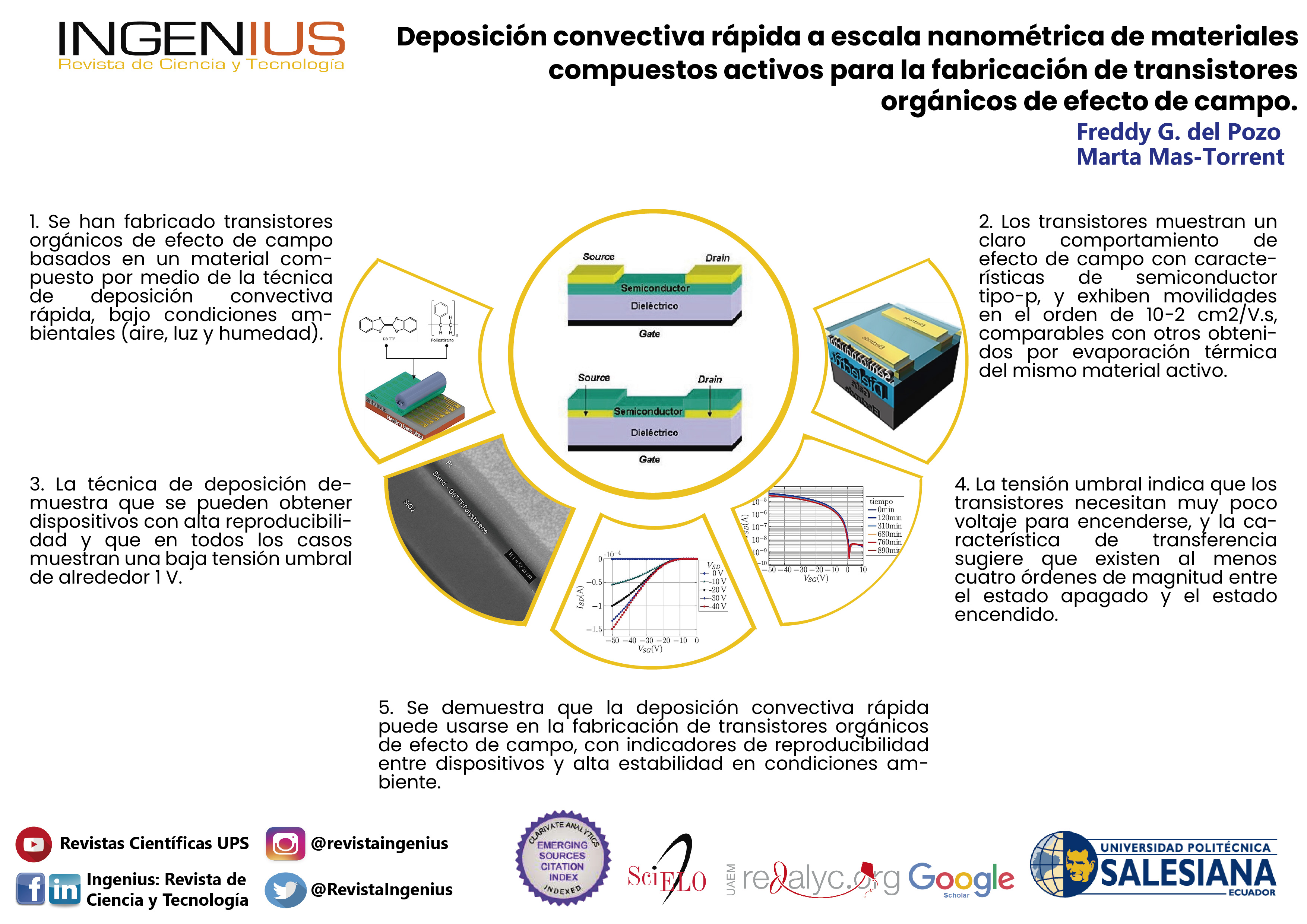
Organic field-effect transistors based on composite materials has been manufactured using the rapid convective deposition technique. The manufacturing was carried out under environmental conditions (air, light and humidity). All manufactured transistors show a typical field-effect behavior with features of a p-type semiconductor, and exhibit field-effect mobilities around 10-2 cm2/V.s, fully comparable with transistors manufactured using thermal evaporation of the same active material. The deposition technique demonstrates that devices may be manufactured with high reproducibility and in all cases with a low threshold voltage of approximately 1V. Therefore, it is demonstrated here that rapid convective deposition can be used to manufacture organic field-effect transistors on large surface areas, showing high reproducibility among devices and high stability at environmental conditions.
Article Details
The Universidad Politécnica Salesiana of Ecuador preserves the copyrights of the published works and will favor the reuse of the works. The works are published in the electronic edition of the journal under a Creative Commons Attribution/Noncommercial-No Derivative Works 4.0 Ecuador license: they can be copied, used, disseminated, transmitted and publicly displayed.
The undersigned author partially transfers the copyrights of this work to the Universidad Politécnica Salesiana of Ecuador for printed editions.
It is also stated that they have respected the ethical principles of research and are free from any conflict of interest. The author(s) certify that this work has not been published, nor is it under consideration for publication in any other journal or editorial work.
The author (s) are responsible for their content and have contributed to the conception, design and completion of the work, analysis and interpretation of data, and to have participated in the writing of the text and its revisions, as well as in the approval of the version which is finally referred to as an attachment.
References
[2] S. Riera-Galindo, F. Leonardi, R. Pfattner, and M. Mas-Torrent, “Organic semiconductor/polymer blend films for organic field-effect transistors,” Advanced Materials Technologies, vol. 4, no. 9, p. 1900104, 2019. [Online]. Available: https://doi.org/10.1002/admt.201900104
[3] C. Wang, H. Dong, L. Jiang, and W. Hu, “Organic semiconductor crystals,” Chemical Society Reviews, vol. 47, pp. 422–500, 2018. [Online]. Available: http://dx.doi.org/10.1039/C7CS00490G
[4] M. Fahlman, S. Fabiano, V. Gueskine, D. Simon, M. Berggren, and X. Crispin, “Interfaces in organic electronics,” Nature Reviews Materials, vol. 4, no. 10, pp. 627–650, Oct. 2019. [Online]. Available: https://doi.org/10.1038/s41578-019-0127-y
[5] Z. A. Lamport, H. F. Haneef, S. Anand, M. Waldrip, and O. D. Jurchescu, “Tutorial: Organic field-effect transistors: Materials, structure and operation,” Journal of Applied Physics, vol. 124, no. 7, p. 071101, 2018. [Online]. Available: https://doi.org/10.1063/1.5042255
[6] M. Mas-Torrent and C. Rovira, “Role of molecular order and solid-state structure in organic field-effect transistors,” Chemical Reviews, vol. 111, no. 8, pp. 4833–4856, 2011, pMID: 21417271. [Online]. Available: https://doi.org/10.1021/cr100142w
[7] K. Shibata, K. Ishikawa, H. Takezoe, H. Wada, and T. Mori, “Contact resistance of dibenzotetrathiafulvalene-based organic transistors with metal and organic electrodes,” Applied Physics Letters, vol. 92, no. 2, p. 023305, 2008. [Online]. Available: https://doi.org/10.1063/1.2834374
[8] B. Noda, H. Wada, K. Shibata, T. Yoshino, M. Katsuhara, I. Aoyagi, T. Mori, T. Taguchi, T. Kambayashi, K. Ishikawa, and H. Takezoe, “Crystal structures and transistor properties of phenyl-substituted tetrathiafulvalene derivatives,” Nanotechnology, vol. 18, no. 42, p. 424009, sep 2007. [Online]. Available: https://doi.org/10.1088/0957-4484/18/42/424009
[9] M. Mas-Torrent, P. Hadley, S. T. Bromley, X. Ribas, J. Tarrés, M. Mas, E. Molins, J. Veciana, and C. Rovira, “Correlation between crystal structure and mobility in organic fieldeffect transistors based on single crystals of tetrathiafulvalene derivatives,” Journal of the American Chemical Society, vol. 126, no. 27, pp. 8546–8553, 2004, pMID: 15238013. [Online]. Available: https://doi.org/10.1021/ja048342i
[10] M. Mas-Torrent, P. Hadley, S. T. Bromley, N. Crivillers, J. Veciana, and C. Rovira, “Singlecrystal organic field-effect transistors based on dibenzo-tetrathiafulvalene,” Applied Physics Letters, vol. 86, no. 1, p. 012110, 2005. [Online]. Available: https://doi.org/10.1063/1.1848179
[11] T. Chonsut, A. Rangkasikorn, S. Wirunchit, A. Kaewprajak, P. Kumnorkaew, N. Kayunkid, and J. Nukeaw, “Rapid convective deposition; an alternative method to prepare organic thin film in scale of nanometer,” Materials Today: Proceedings, vol. 4, no. 5, Part 2, pp. 6134–6139, 2017, international Conference on Science and Technology of the Emerging Materials (July 27-29, 2016), Pattaya, Thailand. [Online]. Available: https://doi.org/10.1016/j.matpr.2017.06.106
[12] F. G. D. Pozo, S. Galindo, R. Pfattner, C. Rovira, and M. Mas-Torrent, “Deposition of composite materials using a wire-bar coater for achieving processability and air-stability in Organic Field-Effect Transistors (OFETs),” in Organic Field-Effect Transistors XIV; and Organic Sensors and Bioelectronics VIII, I. Kymissis, R. Shinar, L. Torsi, I. McCulloch, and O. D. Jurchescu, Eds., vol. 9568, International Society for Optics and Photonics. SPIE, 2015, pp. 17–22. [Online]. Available: https://doi.org/10.1117/12.2186521
[13] L. J. Richter, D. M. DeLongchamp, and A. Amassian, “Morphology development in solution-processed functional organic blend films: An in situ viewpoint,” Chemical Reviews, vol. 117, no. 9, pp. 6332–6366, 2017, pMID: 28414244. [Online]. Available: https://doi.org/10.1021/acs.chemrev.6b00618
[14] A. Tamayo, S. Riera-Galindo, A. O. F. Jones, R. Resel, and M. Mas-Torrent, “Impact of the ink formulation and coating speed on the polymorphism and morphology of a solution-sheared thin film of a blended organic semiconductor,” Advanced Materials Interfaces, vol. 6, no. 22, p. 1900950, 2019. [Online]. Available: https://doi.org/10.1002/admi.201900950
[15] A. M. Hiszpanski, R. M. Baur, B. Kim, N. J. Tremblay, C. Nuckolls, A. R. Woll, and Y.-L. Loo, “Tuning polymorphism and orientation in organic semiconductor thin films via postdeposition processing,” Journal of the American Chemical Society, vol. 136, no. 44, pp. 15 749–15 756, 2014, pMID: 25317987. [Online]. Available: https://doi.org/10.1021/ja5091035
[16] H. Chung and Y. Diao, “Polymorphism as an emerging design strategy for high performance organic electronics,” Journal of Materials Chemistry C, vol. 4, pp. 3915–3933, 2016. [Online]. Available: http://dx.doi.org/10.1039/C5TC04390E
[17] A. Kyndiah, F. Leonardi, C. Tarantino, T. Cramer, R. Millan-Solsona, E. Garreta, N. Montserrat, M. Mas-Torrent, and G. Gomila, “Bioelectronic recordings of cardiomyocytes with accumulation mode electrolyte gated organic field effect transistors,” Biosensors and Bioelectronics, vol. 150, p. 111844, 2020. [Online]. Available: https://doi.org/10.1016/j.bios.2019.111844
[18] A. Brillante, I. Bilotti, R. G. Della Valle, E. Venuti, S. Milita, C. Dionigi, F. Borgatti, A. N. Lazar, F. Biscarini, M. Mas-Torrent, N. S. Oxtoby, N. Crivillers, J. Veciana, C. Rovira, M. Leufgen, G. Schmidt, and L. W. Molenkamp, “The four polymorphic modifications of the semiconductor dibenzo-tetrathiafulvalene,” CrystEngComm, vol. 10, pp. 1899–1909, 2008. [Online]. Available: http://dx.doi.org/10.1039/B810993A
[19] P. A. Bobbert, A. Sharma, S. G. J. Mathijssen, M. Kemerink, and D. M. de Leeuw, “Operational stability of organic field-effect transistors,” Advanced Materials, vol. 24, no. 9, pp. 1146–1158, 2012. [Online]. Available: https://doi.org/10.1002/adma.201104580
[20] M. Mas-Torrent and C. Rovira, “Tetrathiafulvalene derivatives for organic field effect transistors,” Journal of Materials Chemistry, vol. 16, pp. 433–436, 2006. [Online]. Available: http://dx.doi.org/10.1039/B510121B