

Optative professional training courses towards higher education curricula design
Article Sidebar
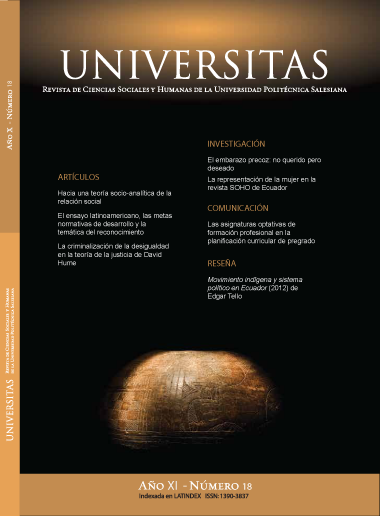
Main Article Content
Abstract
Los cambios que actualmente pretende implementar el gobierno ecuatoriano en las universidades implican y demandan la generación de una serie de reglamentos que deben contribuir a reordenarlas, reorganizarlas y regularlas bajo los lineamientos que los organismos pertinentes dicten y a las normativas internas que las propias universidades establezcan para complementar la legislación estatal.
En este contexto de reformas a la educación superior, inédito para las universidades ecuatorianas que están actualmente sometidas a procesos de evaluación institucional y acreditación de carreras, y en el proceso de elaboración del nuevo Reglamento de Régimen Académico por parte del Consejo de Educación Superior, el tema del diseño de un programa de asignaturas optativas como parte de un currículo de educación superior pretende convertirse en una importante contribución a la etapa de diseño mesocurricular de una carrera universitaria.
Article Details
Universitas-XXI Journal aligns with the principles of open access and academic collaboration by adopting the Creative Commons Attribution-NonCommercial-ShareAlike 4.0 International License (CC BY-NC-SA 4.0). This license ensures that published content can be used and shared widely under the following conditions:
Attribution: Authors and the journal must be appropriately credited as the original creators of the content, with full reference and a link to the publication provided.
Non-commercial use: Content may not be used for commercial purposes, preserving its academic and educational intent.
ShareAlike: Derivative works must be distributed under the same terms as this license, promoting the creation of accessible and equitable knowledge.
By implementing this license, the Universitas-XXI Journal strengthens its commitment to disseminating high-quality research, providing free access to knowledge, and fostering a collaborative environment among researchers, educators, and students worldwide.
This decision reflects core values of responsibility, ethics, and transparency in academia, ensuring that intellectual contributions serve as a foundation for new research and projects while respecting the rights of authors and the scientific community.
For more information about this license, please visit the following link: https://creativecommons.org/licenses/by-nc-sa/4.0/"