

Development of oral comprehension of the English language through the B-learning blended learning in university students
Article Sidebar
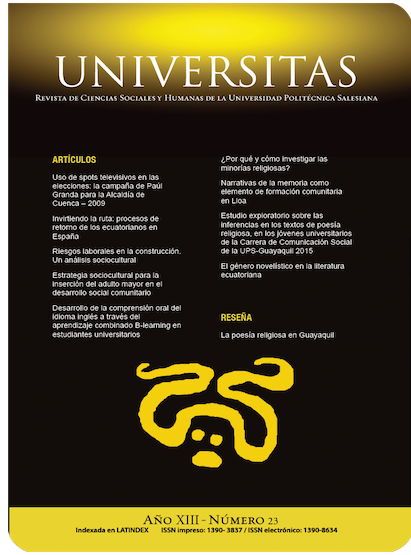
Main Article Content
Abstract
Article Details
Universitas-XXI Journal aligns with the principles of open access and academic collaboration by adopting the Creative Commons Attribution-NonCommercial-ShareAlike 4.0 International License (CC BY-NC-SA 4.0). This license ensures that published content can be used and shared widely under the following conditions:
Attribution: Authors and the journal must be appropriately credited as the original creators of the content, with full reference and a link to the publication provided.
Non-commercial use: Content may not be used for commercial purposes, preserving its academic and educational intent.
ShareAlike: Derivative works must be distributed under the same terms as this license, promoting the creation of accessible and equitable knowledge.
By implementing this license, the Universitas-XXI Journal strengthens its commitment to disseminating high-quality research, providing free access to knowledge, and fostering a collaborative environment among researchers, educators, and students worldwide.
This decision reflects core values of responsibility, ethics, and transparency in academia, ensuring that intellectual contributions serve as a foundation for new research and projects while respecting the rights of authors and the scientific community.
For more information about this license, please visit the following link: https://creativecommons.org/licenses/by-nc-sa/4.0/"
References
virtuales de enseñanza - aprendizaje. Madrid: Narcia,SA D Ediciones.
Barkley, E. F. (2007). Técnicas de aprendizaje colaborativo: Manual para el
profesorado universitario. Madrid: EDICIONES MORATA, S.L.
Cassany, D., Luna, M., & Sanz, G. (2007). Enseñar Lengua. España: Imprimeix.
Jack C., R., & Rodgers, T. (2001). Approaches and Methods in Language Teaching.
New York: Cambridge Language Teaching Llibrary.
Loyo, A. C., & Rivero de Magnago, M. (2005). Las lenguas extranjeras y las nuevas
tecnologías de la comunicación. Argentina .
Martín Martín, J. M. (2000). La lengua materna en el aprendizaje de una segunda
lengua. España: J.de Haro Artes Gráficas, S.L.P.I.S.A Sevilla.
Ministerio de Eduación y Ciencia. (2004). Nuevas formas de aprendizaje en Lenguas
extranjeras. Estilo Estugrf Impresores S.I.
Michael, B. (2004). Blended Learning and Business Change. Chief Learning Office.
Murado Bouso, J. L. (2010). Didáctica de Inglés en educación infantil. Métodos para la
enseñanza y el aprendizaje de la dLengua Inglesa. España: Ideaspropias.
Nesterenko, N. (2008). METHODOLOGY I. Loja - Ecuador: De la Universidad Técnica
Particular de Loja.
Pavesi, M., Vertocchi, D., Hofmannová, M., & Kazianka, M. (2001). Enseñar en una
lengua extranjera. En G. Langé (Ed.). Roma.
Richards, J. C., & Rodgers, T. S. (2001). Approaches and Methods in Language
Teaching. New York: Cambridge University Press.
Rodríguez Illera, J. L. (2008). Comunidades virtuales de práctica y de aprendizaje.
España: PUBLICATIONS 1 EDICIONS DE LA UNIVERSITAT DE BARCELONA.
Ruiz Velasco Sanchez , E. (2013). Tecnologías de la información y la educación para
la innovación educativa. México, D. F.: Edicciones Díaz de Santos.
Silva Salinas, S. (2005). Medios Didácticos Multimedia para el aula. Lass NNTT como
herramientas didácticas en los centros educativos. España: Ideas Propias Editorial.
Zambrano Ayala, W. (2012). Modelo de Aprendizaje Virtual para la Educación Superior
MAVES basado en tecnologías Web 3.0. Bogotá: Ecoe Ediciones.