

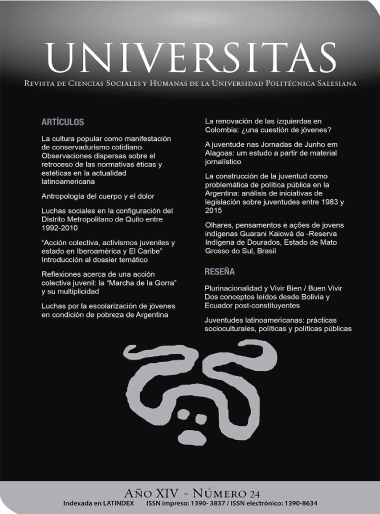
Anthropology of the body and pain
Article Sidebar
Main Article Content
Abstract
pain” that has led the human beings to the exercise of the domain and of the power of some over others
by means of the pain application on the bodies; for example the ideological mastery of religious dye
exercised by the Hebrew patriarchs, the educated Sumerian, Mesopotamian, Egyptian, Greek, Roman,
Aztec, Mayan, Inca, etc. During the Middle Ages, this one was stated realize with more clarity. A body
tortured, submitted to the pain and to the torture is not but a pedagogic modality for its congeners. The
fear, the terror are bosses who design a type of human conduct, they do of the human beings a few instruments
of utility of the powerful ones, of the delinquents, of the drug traffickers whose only intention is
to increase its empire of the capital for the power of the weapon.
Article Details
Universitas-XXI Journal aligns with the principles of open access and academic collaboration by adopting the Creative Commons Attribution-NonCommercial-ShareAlike 4.0 International License (CC BY-NC-SA 4.0). This license ensures that published content can be used and shared widely under the following conditions:
Attribution: Authors and the journal must be appropriately credited as the original creators of the content, with full reference and a link to the publication provided.
Non-commercial use: Content may not be used for commercial purposes, preserving its academic and educational intent.
ShareAlike: Derivative works must be distributed under the same terms as this license, promoting the creation of accessible and equitable knowledge.
By implementing this license, the Universitas-XXI Journal strengthens its commitment to disseminating high-quality research, providing free access to knowledge, and fostering a collaborative environment among researchers, educators, and students worldwide.
This decision reflects core values of responsibility, ethics, and transparency in academia, ensuring that intellectual contributions serve as a foundation for new research and projects while respecting the rights of authors and the scientific community.
For more information about this license, please visit the following link: https://creativecommons.org/licenses/by-nc-sa/4.0/"
References
2003 Antropología de la religión: una aproximación interdisciplinar a las religiones antiguas y contemporáneas. España: Editorial UOC. Retrieved from http://www.ebrary.com
De Jerusalén, B.
1998 Nueva edición revisada y aumentada. Desclée de Brouwer, Bilbao.
Duch, L., & Mèlich, J.
2012 Escenarios de la corporeidad. España: Editorial Trotta, S.A.. Retrieved from http://www.ebrary.com
Garrido, M. E., Masip, P. J., & Herrero, A. C.
2009 Autoeficacia y delincuencia. España: Dykinson. Retrieved from http://www.ebrary.com
González Suárez, Federico
1989 Estudio Histórico de los Cañaris, Biblioteca ecuatoriana clásica, Quito, Ecuador.
Gubem, R.
1996 Del bisonte a la realidad virtual. La escena y.
JÜNEMANN BECKSCHAEFER, Guillermo,
1992 La Sagrada Biblia, Versión de la septuaginta al español. Versión directa del griego, hebreo y arameo. Según los mejores códices: Vaticano, Sinaítico, Alejandrino y sus mejores ediciones. Texto bíblico autorizado para su publicación por la Conferencia Episcopal de Chile mediante el decreto n. 70 (860/92) con fecha del 8 de octubre de 1992. Documento electrónico de distribución gratuita preparado por VE Multimedios (www.vemultimedios.org) como un servicio a la Iglesia.
León, A. A.
2005 La condición de héroe. Chile: Red PHARO. Retrieved from http://www.ebrary.com
López, A. I.
1998 Mujeres y Familia en la Edad Media. (Spanish). Historia Critica, (16), 1.
Marcos, M. (Ed.).
2010 Herejes en la historia. España: Editorial Trotta, S.A.. Retrieved from http://www.ebrary.com
Martí, J., & Martí, J.
2008 Los pueblos indígenas y La cultura del cuerpo. España: Editorial UOC. Retrieved from http://www.ebrary.com
MIRÓ LLINARES, Fernando, AGUSTINA SANLLEHÍ, José Ramón, MEDINA SARMIENTO, José E.
2015 Crimen, oportunidad y vida diaria: libro homenaje al Profesor Dr. Marcus Felson, Editorial Dykinson.
Newiger, C., & Beinborn, B.
2002 Osteopatía: una ayuda para su hijo; un tratamiento suave sin efectos secundarios; Cómo actúa frente a los achaques más frecuentes; lo que uno mismo puede hacer. [Barcelona]: Editorial Paidotribo.
Prat, I. P. R.
2009 Y les lavó los pies: una antropología según el Evangelio. España: Editorial Milenio. Retrieved from http://www.ebrary.com
Quezada, A.
2011 La industria farmacéutica en el Ecuador: mirando hacia adelante. Revista E+ E Espae y Empresa, (2).
Quiñones Arocho, M. I.
2004 El fin del reino de lo propio: ensayos de antropología cultural. México: Gobierno del Estado de Quintana Roo.
Rodríguez, R. J. L.
2006 Autonomía y dependencia: la divinización del cuerpo. España: Red Nómadas. Retrieved from http://www.ebrary.com
Rodríguez-Shadow, María, and Ávila, Ricardo.
2010 Santuarios, peregrinaciones y religiosidad popular. México: Universidad de Guadalajara. ProQuest ebrary. Web. 18 June 2015.
Rucquoi, A.
1978 Historia de un tópico: la mujer en la Edad Media. Historia 16, (21), 104-113.
SAGUAR GARCIA, A.
2014 '¿Cuál dolor puede ser tal / que se iguale con mi mal?': entre la poesía de cancionero y la intertextualidad bíblica. (Spanish). Bulletin Of Hispanic Studies (1475-3839), 91(8), 1015-1024.
Santa, T. D. J.
2004 Las Moradas. Argentina: El Cid Editor. Retrieved from http://www.ebrary.com
Tobar, F.
2008 Economía de los medicamentos genéricos en América Latina. Rev Panam Salud Publica, 23(1), 59-67.
Torres, M., & Compañ, V.
2006 La experiencia del dolor. España: Editorial UOC. Retrieved from http://www.ebrary.com
Uribe, A. A. B.
2006 Notas sobre la representación del cuerpo en la obra de Michel Foucault. Mexico: Red Estudios sobre las Culturas Contemporáneas. Retrieved from http://www.ebrary.com
Valdivia Roldán, M.
2011 Gastritis y gastropatías. Revista de Gastroenterología del Perú, 31(1), 38-48.
Vásquez, R. A.
2010 Zygmunt Bauman: modernidad líquida y fragilidad humana. Nómadas. Revista Crítica de Ciencias Sociales y Jurídicas. 19(3): 309-316, 2008. España: Universidad Complutense de Madrid. Retrieved from http://www.ebrary.com