

Apoyo de la alta dirección, capacidades gerenciales digitales y desempeño sostenible: diferencias según el género del liderazgo en empresas manufactureras mexicanas
Barra lateral del artículo
Contenido principal del artículo
Resumen
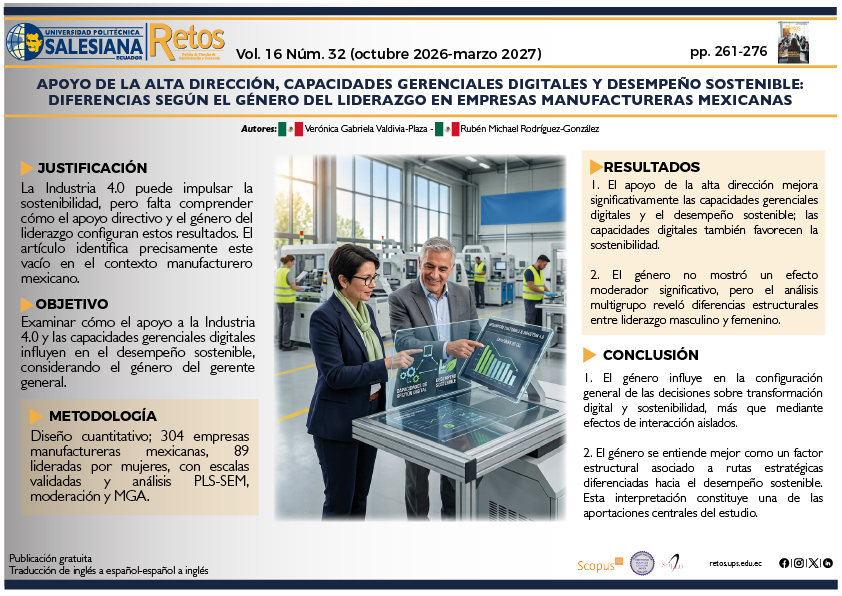
La transformación digital y la sostenibilidad son temas importantes para las compañías manufactureras en estos tiempos donde las compañías compiten en mercados en los que el consumidor es más consciente de su entorno y el impacto que tiene en el planeta, la Industria 4.0 representa un factor estratégico para minimizar estos impactos y lograr los objetivos de desempeño a mediano y largo plazo. Sin embargo, aún es necesario comprender cómo el apoyo de la alta dirección impulsa la adopción de esta industria y de qué manera el género del liderazgo influye en dicha adopción. Por ello, este estudio tiene como objetivo examinar el papel del apoyo de la alta dirección a la Industria 4.0 en el desarrollo de capacidades de gestión digital y en el desempeño sostenible, considerando la influencia del género. Mediante un enfoque cuantitativo y el modelado de ecuaciones estructurales de mínimos cuadrados parciales (PLS-SEM), con datos de 304 compañías manufactureras de México, de las cuales 89 de ellas son dirigidas por gerentes generales femeninos. Los resultados confirman que el apoyo de la alta dirección mejora significativamente las capacidades de gestión digital y el desempeño sostenible, y que las capacidades de gestión digital contribuyen positivamente a los resultados de sostenibilidad. Sin embargo, el género no muestra un efecto moderador significativo en estas relaciones. Por el contrario, el análisis multigrupo (MGA) revela diferencias estructurales entre el liderazgo masculino y femenino.
Detalles del artículo

Esta obra está bajo una licencia internacional Creative Commons Atribución-NoComercial-CompartirIgual 4.0.
Autoría: La lista de autores firmantes debe incluir únicamente a aquellas personas que hayan contribuido intelectualmente al desarrollo del trabajo. La colaboración en la recogida de datos no es, por sí misma, criterio suficiente de autoría. "Retos" declina toda responsabilidad por posibles conflictos derivados de la autoría de los trabajos que se publiquen.
Derechos de autor: La Universidad Politécnica Salesiana preserva los derechos de autor de los artículos publicados, y favorece y permite su reutilización bajo la licencia Creative Commons Attribution-NonCommercial-ShareAlike 3.0 Ecuador. Pueden ser copiados, utilizados, difundidos, transmitidos y expuestos públicamente, siempre y cuando: i) se cite la autoría y la fuente original de su publicación (revista, editorial y URL del trabajo); (Ii) no se utilicen con fines comerciales; Iii) se mencione la existencia y especificaciones de esta licencia.
Referencias
Ahmed, Y., Elsayed, M., Xu, B. y Vento, G. (2024). On the road to sustainability: The role of board characteristics in driving ESG performance in Africa. Socio-Economic Planning Sciences, 95, 1-9. https://doi.org/10.1016/j.seps.2024.101994
Alodat, A., Salleh, Z., Hashim, H. y Sulong, F. (2022). Corporate governance and firm performance: empirical evidence from Jordan. Journal of Financial Reporting and Accounting, 20(5), 866-896, https://doi.org/10.1108/JFRA-12-2020-0361
Appio, F., Frattini, F., Petruzzelli, A. y Neirotti, P. (2021). Digital transformation and innovation management: a synthesis of existing research and an agenda for future studies. Journal of Product Innovation Management, 38(1), 4-20. https://doi.org/10.1111/jpim.12562
Bag, S., Gupta, S. y Kumar, S. (2021). Industry 4.0 adoption and 10R advance manufacturing capabilities for sustainable development. International Journal of Production Economics, 231, 107844. https://doi.org/10.1016/j.ijpe.2020.107844
Beck, J. y Wiersema, M. (2013). Executive decision making: Linking dynamic managerial capabilities to the resource portfolio and strategic outcomes. Journal of Leadership and Organizational Studies, 20(4), 408-419. https://doi.org/10.1177/1548051812471722
Carpenter, M., Geletkanycz, M. y Sanders, W. (2004). Upper echelons research revisited: antecedents, elements, and consequences of top management team composition. Journal of Management, 30(6), 749-778. https://doi.org/10.1016/j.jm.2004.06.001
Castanias, R. y Helfat, C. (2001). The managerial rents model: Theory and empirical analysis. Journal of Management, 27(6), 661-678. https://doi.org/10.1177/014920630102700604
Chen, Y., Li, R. y Song, T. (2023). Does TMT internationalization promote corporate digital transformation? A study based on the cognitive process mechanism. Business Process Management Journal, 29(2), 309-338. https://doi.org/10.1108/BPMJ-06-2021-0376
Cinar Altintas, F. y Hakan Altintas, M. (2008). The relationship between feminist/womanist identity and leadership styles of women managers in Turkey. Gender in Management: An International Journal, 23(3), 175-193. https://doi.org/10.1108/17542410810866935
D'Amato, D., Droste, N., Winkler, K. y Toppinen, A. (2019). Thinking green, circular or bio: Eliciting researchers' perspectives on a sustainable economy with Q method. Journal of Cleaner Production, 230, 460-476. https://doi.org/10.1016/j.jclepro.2019.05.099
Dezso, C. y Ross, D. (2012). Does female representation in top management improve firm performance? A panel data investigation. Strategic Management Journal, 33(9), 1072–1089. https://doi.org/10.1002/smj.1955
Fornell, C. y Larcker, D. (1981). Evaluating structural equation models with unobservable variables and measurement error. Journal of Marketing Research, 18(1), 39-50. https://doi.org/10.1177/002224378101800104
Guo, H., Xi, Y., Zhang, X., Zhao, J. y Tang, J. (2013). The role of top managers’ human and social capital in business model innovation. Chinese Management Studies, 7(3), 447-469. https://doi.org/10.1108/CMS-03-2013-0050
Hair, J., Hult, G., Ringle, C. y Sarstedt, M. (2022). A primer on partial least squares structural equation modeling (PLS-SEM) (3rd ed.). Sage.
Hambrick, D. (2007). Upper echelons theory: An update. Academy of Management Review, 32(2), 334-343. https://doi.org/10.2307/20159303
Hambrick, D. y Mason, P. (1984). Upper echelons: The organization as a reflection of its top managers. Academy of Management Review, 9(2), 193-206. https://doi.org/10.2307/258434
Harrison, D. y Klein, K. (2007). What's the difference? Diversity constructs as separation, variety, or disparity in organizations. Academy of Management Review, 32(4), 1199-1228. https://doi.org/10.5465/amr.2007.26586096
Henseler, J., Hubona, G. y Ray, P. (2016). Using PLS path modeling in new technology research: Updated guidelines. Industrial Management & Data Systems, 116(1), 2-20. https://doi.org/10.1108/IMDS-09-2015-0382
Henseler, J., Ringle, C. y Sinkovics, R. (2009). The use of partial least squares path modeling in international marketing. New Challenges to International Marketing. https://doi.org/10.1108/S1474-7979(2009)0000020014
Instituto Nacional de Estadística y Geografía. (s. f.). Directorio Estadístico Nacional de Unidades Económicas (DENUE). https://bit.ly/4qdpSJr
Instituto Nacional de Estadística y Geografía. (2023). Directorio Estadístico Nacional de Unidades Económicas (DENUE) [Conjunto de datos]. https://www.inegi.org.mx/
Khan, R., Saqib, A., Abbasi, M., Mikhaylov, A. y Pinter, G. (2023). Green leadership, environmental knowledge sharing, and sustainable performance in manufacturing industry: Application from upper echelon theory. Sustainable Energy Technologies and Assessments, 60, 103540. https://doi.org/10.1016/j.seta.2023.103540
Kock, N. (2015). Common method bias in PLS-SEM: A full collinearity assessment approach. International Journal of e-Collaboration (IJeC), 11(4), 1-10. https://doi.org/10.4018/ijec.2015100101
Koryak, O., Lockett, A., Hayton, J., Nicolau, N. y Mole, K. (2018). Disentangling the antecedents of ambidexterity: Exploration and exploitation. Research Policy, 47(2), 413-427. https://doi.org/10.1016/j.respol.2017.12.003
Liebana-Cabanillas, F., Rodriguez-Lopez, M., Abbasi, G. y Higueras-Castillo, E. (2025). A behavioral study of food delivery service by drones: Insights from urban and rural consumers. International Journal of Hospitality Management, 127, 104098. https://doi.org/10.1016/j.ijhm.2025.104098
Mansour, M., Shubita, M., Lutfi, A., Saleh, M. y Saad, M. (2024b). Female CEOs and green innovation: Evidence from Asian firms. Sustainability, 16(21), 9404. https://doi.org/10.3390/su16219404
Mansour, M., Zobi, M., Eleimat, D., Alim, S. y Marei, A. (2024a). Board gender diversity and bank performance in Jordan. Business Perspectives, 19, 183-194. https://doi.org/10.21511/bbs.19(1).2024.16
Martinez-Caro, E., Cegarra-Navarro, J. y Alfonso-Ruiz, F. (2020). Digital technologies and firm performance: The role of digital organisational culture. Technological Forecasting and Social Change, 154, 119962. https://doi.org/10.1016/j.techfore.2020.119962
Mehmood, A., De Luca, F. y Quach, H. (2023). Investigating how board gender diversity affects environmental, social and governance performance: Evidence from the utilities sector. Utilities Policy, 83, 101588. https://doi.org/10.1016/j.jup.2023.101588
Nielsen, S. (2010). Top management team diversity: A review of theories and methodologies. International Journal of Management Reviews, 12(3), 301-316. https://doi.org/10.1111/j.1468-2370.2009.00263.x
OECD. (2024). OECD economic outlook, volume 2024 issue 2: Resilience in uncertain times. https://doi.org/10.1787/d8814e8b-en
Podsakoff, P., MacKenzie, S., Lee, J. y Podsakoff, N. (2003). Common method biases in behavioral research: A critical review of the literature and recommended remedies. Journal of Applied Psychology, 88(5), 539-569. https://doi.org/10.1037/0021-9010.88.5.879
Rasheed, R., Rashid, A. y Ngah, A. (2025). Role of leadership styles to foster innovative capabilities and green purchasing. Journal of Global Operations and Strategic Sourcing, 18(2), 328-348. https://doi.org/10.1108/JGOSS-05-2023-0047
Sousa-Zomer, T., Neely, A. y Martinez, V. (2020). Digital transforming capability and performance: A microfoundational perspective. International Journal of Operations & Production Management, 40(7/8), 1095-1128. https://doi.org/10.1108/IJOPM-06-2019-0444
Sovacool, B. y In, J. (2026). Harness gender empowerment to achieve climate justice, sustainability, and equity. Environmental Science and Policy, 176, 104314. https://doi.org/10.1016/j.envsci.2026.104314
Teece, D. (2007). Explicating dynamic capabilities: The nature and microfoundations of (sustainable) enterprise performance. Strategic Management Journal, 28(13), 1319-1350. https://doi.org/10.1002/smj.640
Vafaei, A., Henry, D., Ahmed, K. y Alipuor, M. (2021). Board diversity: Female director participation and corporate innovation. International Journal of Accounting and Information Management, 29(2), 247-279. https://doi.org/10.1108/IJAIM-06-2020-0080
Venturelli, A., Caputo, A., Pizzi, S. y Valenza, G. (2022). A dynamic framework for sustainable open innovation in the food industry. British Food Journal, 124(6), 1895-1911. https://doi.org/10.1108/BFJ-03-2021-0293
Warner, K. y Wager, M. (2019). Building dynamic capabilities for digital transformation: An ongoing process of strategic renewal. Long Range Planning, 52(3), 326-349. https://doi.org/10.1016/j.lrp.2018.12.001
Yu, T., Teoh, A., Bian, Q., Liao, J. y Wang, C. (2025a). Can virtual influencers affect purchase intentions in tourism and hospitality e-commerce live streaming? An empirical study in China. International Journal of Contemporary Hospitality Management, 37(1), 216-238. https://doi.org/10.1108/IJCHM-03-2024-0358
Yu, T., Teoh, A., Liao, J. y Wang, C. (2025b). How do virtual influencers drive impulsive buying behaviour in e-commerce live streaming: The effects of parasocial relationship and influencer-product fit. Behaviour & Information Technology, 1-31. https://doi.org/10.1080/0144929X.2025.2551579