

Impacto de los sectores económicos en la huella ecológica global: regresión cuantílica
Barra lateral del artículo
Contenido principal del artículo
Resumen
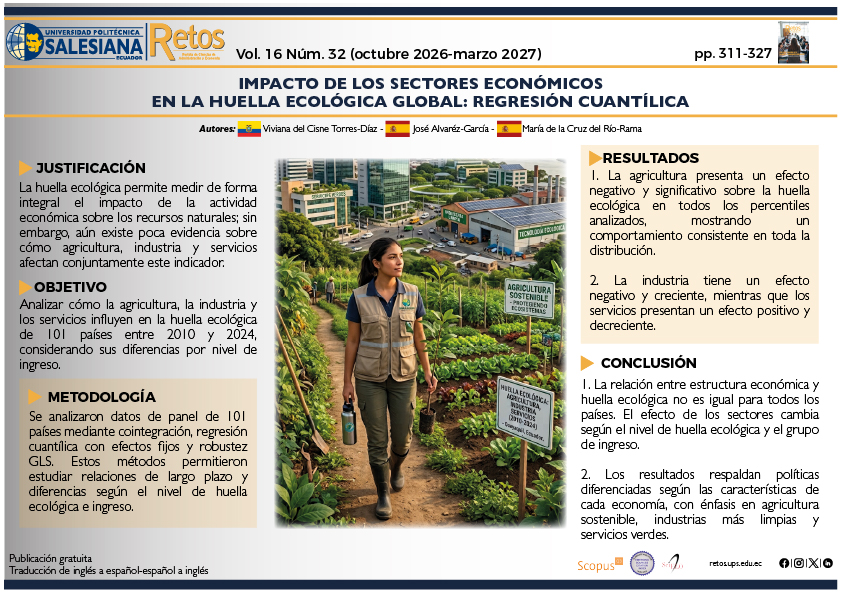
El actual deterioro ambiental demanda indicadores capaces de capturar el impacto real que las economías ejercen sobre los ecosistemas. Para lo cual, la huella ecológica se emplea como una métrica integral que vincula la producción, el consumo y la biocapacidad de los territorios, no obstante, la literatura no ha examinado cómo afectan en conjunto los tres sectores económicos a la huella ecológica. Este estudio analiza el impacto del valor agregado de la agricultura, la industria y los servicios sobre la huella ecológica de 101 países entre 2010 y 2024. Los resultados confirman cointegración de largo plazo en los grupos de ingreso alto, medio alto y bajo. En los cuantiles, la agricultura muestra un efecto negativo y significativo en toda la distribución; la industria es negativa en el percentil 10 y positiva a partir del 20; y los servicios presentan un efecto positivo y decreciente, no significativo en el percentil 90. El modelo GLS confirma la dirección de estos resultados a nivel global, aunque introduce heterogeneidad relevante por grupo de ingreso para los tres sectores. Estos hallazgos respaldan el uso de la huella ecológica como medida integral al demostrar que la relación entre el cambio estructural y la sostenibilidad depende del nivel de ingreso y la posición ecológica del país, lo que exige políticas diferenciadas orientadas a industrias limpias, servicios verdes y agricultura sostenible.
Detalles del artículo

Esta obra está bajo una licencia internacional Creative Commons Atribución-NoComercial-CompartirIgual 4.0.
Autoría: La lista de autores firmantes debe incluir únicamente a aquellas personas que hayan contribuido intelectualmente al desarrollo del trabajo. La colaboración en la recogida de datos no es, por sí misma, criterio suficiente de autoría. "Retos" declina toda responsabilidad por posibles conflictos derivados de la autoría de los trabajos que se publiquen.
Derechos de autor: La Universidad Politécnica Salesiana preserva los derechos de autor de los artículos publicados, y favorece y permite su reutilización bajo la licencia Creative Commons Attribution-NonCommercial-ShareAlike 3.0 Ecuador. Pueden ser copiados, utilizados, difundidos, transmitidos y expuestos públicamente, siempre y cuando: i) se cite la autoría y la fuente original de su publicación (revista, editorial y URL del trabajo); (Ii) no se utilicen con fines comerciales; Iii) se mencione la existencia y especificaciones de esta licencia.
Referencias
Adekoya, O.B.; Ajayi, G.E.; Suhrab, M.; Oliyide, J.A. (2022). How critical are resource rents, agriculture, growth, and renewable energy to environmental degradation in resource-rich African countries? The role of institutional quality. Energy Policy, 164, 112888. https://doi.org/10.1016/j.enpol.2022.112888
Ahmad, A. U., Abubakar, A., Senan, N., Gwadabe, U. M., Mohammed, B., Muhammad, M., Al-Yazidi, A. M., Sani, B. Y., Jamiu, M. y Mustapha, U. A. (2024). Examining the Asymmetric Effects of Renewable Energy Use, Financial Development, and Trade Openness on Economic Growth in D-8 Islamic Countries. International Journal of Energy Economics and Policy, 14(4), 125-139. https://doi.org/10.32479/ijeep.16077
Alvarado, R.; Tillaguango, B.; Dagar, V.; Ahmad, M.; Işık, C.; Méndez, P.; Toledo, E. (2021). Ecological footprint, economic complexity and natural resource rents in Latin America. Journal of Cleaner Production, 318, 128585. https://doi.org/10.1016/j.jclepro.2021.128585
Alper, A. E., Alper, F. O., Ozayturk, G. y Mike, F. (2023). Testing the long-run impact of economic growth, energy consumption, and globalization on ecological footprint: new evidence from Fourier bootstrap ARDL and Fourier bootstrap Toda–Yamamoto test results. Environmental Science and Pollution Research, 30(15), 42873-42888. https://doi.org/10.1007/s11356-022-18610-7
Azam, M., Nawaz, S., Rafiq, Z. y Iqbal, N. (2021). A spatial-temporal decomposition of carbon emission intensity: a sectoral level analysis in Pakistan. Environmental Science and Pollution Research, 28(17), 21381- 21395. https://doi.org/10.1007/s11356-020-12088-x
Banco Mundial. (2026). Datos por país. https://datos.bancomundial.org/pais
Chowdhury, M.A.F.; Shanto, P.A.; Ahmed, A.; Rumana, R.H. (2021). Does foreign direct investment impair the ecological footprint? Environmental Science and Pollution Research, 28(12), 14372-14385. https://doi.org/10.1007/s11356-020-11518-0
Chu, L. y Hoang, D. (2021). The shadow economy-environmental quality nexus in OECD countries: empirical evidence from panel quantile regression. Environmental Science and Pollution Research, 29(43), 65233- 65258. https://doi.org/10.1007/s11356-022-20410-y
Destek, M. A. y Sarkodie, S. A. (2019). Investigation of environmental Kuznets curve for ecological footprint: the role of energy and financial development. Science of the total environment, 650, 2483-2489. https://doi.org/10.1016/j.scitotenv.2018.10.017
Dogan, E.; Altinoz, B.; Madaleno, M.; Taskin, D. (2020). The impact of renewable energy consumption to economic growth: a replication and extension of Inglesi-Lotz (2016). Energy Economics, 90, 104866. https://doi.org/10.1016/j.eneco.2020.104866
Dinga, G. D. (2023). The ecological poverty trap: Addressing the role of structural change, economic growth, trade, capital formation and democracy. Environmental and Sustainability Indicators, 18, 100245. https://doi.org/10.1016/j.indic.2023.100245
Ehigiamusoe, K., Lee, C. y Lean, H.-H. L. (2025). Analysis of the economic and environmental imperatives of the service sector: The role of government in promoting sustainable development. Journal of environmental management, 376, 124470. https://doi.org/10.1016/j.jenvman.2025.124470
Fanning, A. L. y Raworth, K. (2025). Doughnut of social and planetary boundaries monitors a world out of balance. Nature, 646, 47 - 56. https://doi.org/10.1038/s41586-025-09385-1
Global Footprint Network. (2026). Open Data Platform. https://footprintnetwork.org/licenses/public-data-package-free/
Hoechle, D. (2007). Robust Standard Errors for Panel Regressions with Cross-Sectional Dependence. The Stata Journal, 7(3), 281 - 312. https://doi.org/10.1177/1536867x0700700301
Kazemzadeh, E., Fuinhas, J. A., Koengkan, M. y Osmani, F. (2022). The heterogeneous effect of economic complexity and export quality on the ecological footprint: a two-step club convergence and panel quantile regression approach. Sustainability, 14(18), 11153. https://doi.org/10.3390/su141811153
Kazemian, S., Zaman, R., Iranmanesh, M. y Sanusi, Z. M. (2024). Assessing the carbon footprint of the agriculture, forestry, and fishing industry of Australia. Sustainability Accounting, Management and Policy Journal, 16(5), 1243-1268. https://doi.org/10.1108/sampj-08-2023-0610
Kongbuamai, N., Bui, Q. y Nimsai, S. (2021). The effects of renewable and nonrenewable energy consumption on the ecological footprint: the role of environmental policy in BRICS countries. Environmental Science and Pollution Research, 28(22), 27885-27899. https://doi.org/10.1007/s11356-021-12551-3
Kouton, J., Kakou, J. D. y Okoua, Y. M. (2024). Sectoral dynamics and environmental quality in Côte d‘Ivoire: assessing the impact of structural transformation. Cogent Economics & Finance, 12(1), 2413659. https://doi.org/10.1080/23322039.2024.2413659
Liao, J., Liu, X., Zhou, X. y Tursunova, N. (2022). Analyzing the role of renewable energy transition and industrialization on ecological sustainability: Can green innovation matter in OECD countries. Renewable Energy, 204, 141-151. https://doi.org/10.1016/j.renene.2022.12.089
Machado, J. A. y Silva, J. S. (2019). Quantiles via moments. Journal of econometrics, 213(1), 145-173. https://doi.org/10.1016/j.jeconom.2019.04.009
Masud, R. y Enam, J. B. (2023). Consideration of the impact of the transition from a cash crop economy on the carbon footprint. Technology audit and production reserves. https://doi.org/10.15587/2706-5448.2023.286236
Merz, J. J., Barnard, P., Rees, W., Smith, D., Maroni, M., Rhodes, C. J., Dederer, J. H., Bajaj, N., Joy, M. K., Wiedmann, T. y Sutherland, R. (2023). World scientists’ warning: The behavioural crisis driving ecological overshoot. Science Progress, 106(3), 00368504231201372. https://doi.org/10.1177/00368504231201372
Muoneke, O.B., Okere, K.I. & Nwaeze, C.N. (2022). Agriculture, globalization, and ecological footprint: the role of agriculture beyond the tipping point in the Philippines. Environmental Science Pollution Research, 29(36), 54652–54676. https://doi.org/10.1007/s11356-022-19720-y
Pea-Assounga, J. B. B., Bambi, P. D. R. y Apendi, D. A. O. (2025). Impact of agriculture, industry, food production, renewable energy consumption, urbanization, and consumer price index on ecological footprint: evidence from Asian economies. Frontiers in Sustainable Food Systems, 9, 1653025. https://doi.org/10.3389/fsufs.2025.1653025
Pesaran, M. H. (2015). Testing weak cross-sectional dependence in large panels. Econometric reviews, 34(6-10), 1089-1117. https://doi.org/10.1080/07474938.2014.956623
Pesaran, M. H. (2007). A simple panel unit root test in the presence of cross‐section dependence. Journal of applied econometrics, 22(2), 265-312. https://doi.org/10.1002/jae.951
Pesaran, M. H., Schuermann, T. y Weiner, S. M. (2004). Modeling regional interdependencies using a global error-correcting macroeconometric model. Journal of Business & Economic Statistics, 22(2), 129-162. https://doi.org/10.1198/073500104000000019
Pesaran, M. H. (2003). Estimation and inference in large heterogenous panels with cross section dependence. Available at SSRN 385123.
Sahoo, M., Kaushik, S., Gupta, M., Islam, M. K. y Nayak, P. (2024). Powering a sustainable future: Does economic structure influence the ecological footprint?. Sustainable Development, 32(4), 3809-3823. https://doi.org/10.1002/sd.2874
Torres-Díaz, V., del Río-Rama, M. D. L. C., Álvarez-García, J. y Simonetti, B. (2025). Environmental sustainability and tourism growth: convergence or compensation?. Quality & Quantity, 59(3), 2129-2152. https://doi.org/10.1007/s11135-024-01906-w
Usman, A., Ozturk, I., Naqvi, S. M. M. A., Ullah, S. y Javed, M. I. (2022). Revealing the nexus between nuclear energy and ecological footprint in STIRPAT model of advanced economies: Fresh evidence from novel CS-ARDL model. Progress in Nuclear Energy, 148, 104220. https://doi.org/10.1016/j.pnucene.2022.104220
Wang, Q., Wang, X. y Li, R. (2021). Does urbanization redefine the environmental Kuznets curve? An empirical analysis of 134 Countries. Sustainable Cities and Society, 76, 103382. https://doi.org/10.1016/j.scs.2021.103382
Westerlund, J. y Edgerton, D. L. (2007). New improved tests for cointegration with structural breaks. Journal of time series Analysis, 28(2), 188-224. https://doi.org/10.1111/j.1467-9892.2006.00504.x
Wu, D., Wu, G. y Yang, H. (2022). Analysis of China’s Embodied Ecological Footprint and Its Flows among Economic Sectors per Unit of Currency Production. Land, 12(1), 41. https://doi.org/10.3390/land12010041
Xu, Y., Li, C. y Wang, J. (2023). How does agricultural global value chain affect ecological footprint? The moderating role of environmental regulation. Sustainable Development, 31(4), 2416-2427. https://doi.org/10.1002/sd.2518
Yang, X.-R., Chen, J., Li, D. y Li, R. (2023). Functional-Coefficient Quantile Regression for Panel Data with Latent Group Structure. Journal of business & economic statistics: a publication of the American Statistical Association, 42(3), 1026 - 1040. https://doi.org/10.1080/07350015.2023.2277172
Yaxin, X. y Hassan, A. (2025). Aligning Growth, Finance, and Technology With Sustainable Development: Quantile Evidence on Carbon and Ecological Dynamics in G20 Economies. Sustainable Development, 34(3), 3654-3671. https://doi.org/10.1002/sd.70516
Yılancı, V., Çütcü, İ. y Araci, S. (2022). The causality relationship between trade and environment in G7 countries: evidence from dynamic symmetric and asymmetric bootstrap panel causality tests. Mathematics, 10(15), 2553. https://doi.org/10.3390/math10152553
You, W.; Lv, Z. (2018). Spillover effects of economic globalization on CO2 emissions: a spatial panel approach. Energy Economics, 73, 248–257. https://doi.org/10.1016/j.eneco.2018.05.016