

Determinantes visuales del engagement de los envases sostenibles en Pinterest
Barra lateral del artículo
Contenido principal del artículo
Resumen
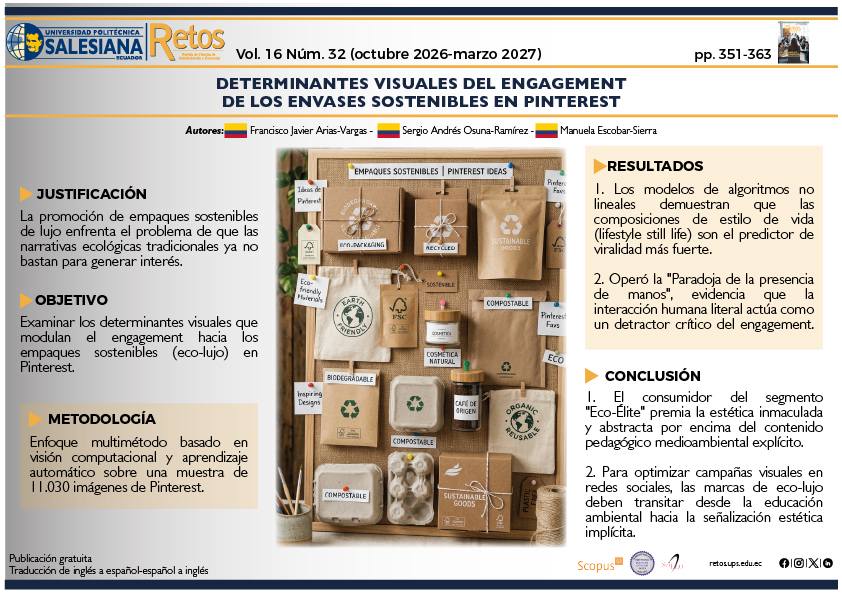
Promover empaques sostenibles en el entorno digital genera una clara fricción estética: las narrativas ecológicas tradicionales ya no bastan para impulsar el engagement dentro de segmentos de alta gama. Esta investigación examina los determinantes visuales que modulan la interacción hacia el eco-lujo en Pinterest, contrastando la “paradoja de la presencia de manos” y el rendimiento de la materialidad premium frente a la estética rústica. Desde la convergencia entre la psicología de la Gestalt, la teoría de la señalización y el antropomorfismo, se analiza la transición desde la pedagogía medioambiental explícita hacia la señalización estética implícita. Metodológicamente, se adopta un enfoque multimétodo que procesa N=11,030 registros de Pinterest, donde el engagement se operacionalizó a partir de las interacciones de los usuarios (reacciones, comentarios y guardados), mediante visión computacional, regresión por mínimos cuadrados ordinarios (MCO), potenciación del gradiente (GBR) y agrupación K-means. Los hallazgos revelan que los modelos no lineales superan a los lineales (R²=0.2025) e identifican las composiciones de naturaleza muerta orientadas al estilo de vida y las paletas de “verdes botánicos” como predictores más robustos de la viralidad. La presencia de manos actúa como detractor crítico del engagement (β=-0.4599; p<0.001), mientras que el segmento Eco-Élite alcanza mayor interacción mediante composiciones abstractas, no infografías educativas. El estudio aporta una taxonomía inédita de eco-personas digitales, proporcionando a los profesionales herramientas prácticas para segmentar consumidores, orientar el diseño de empaques y optimizar las campañas visuales en redes sociales enfocadas en el lujo sostenible.
Detalles del artículo

Esta obra está bajo una licencia internacional Creative Commons Atribución-NoComercial-CompartirIgual 4.0.
Autoría: La lista de autores firmantes debe incluir únicamente a aquellas personas que hayan contribuido intelectualmente al desarrollo del trabajo. La colaboración en la recogida de datos no es, por sí misma, criterio suficiente de autoría. "Retos" declina toda responsabilidad por posibles conflictos derivados de la autoría de los trabajos que se publiquen.
Derechos de autor: La Universidad Politécnica Salesiana preserva los derechos de autor de los artículos publicados, y favorece y permite su reutilización bajo la licencia Creative Commons Attribution-NonCommercial-ShareAlike 3.0 Ecuador. Pueden ser copiados, utilizados, difundidos, transmitidos y expuestos públicamente, siempre y cuando: i) se cite la autoría y la fuente original de su publicación (revista, editorial y URL del trabajo); (Ii) no se utilicen con fines comerciales; Iii) se mencione la existencia y especificaciones de esta licencia.
Referencias
Aggarwal, P. y McGill, A. L. (2007). Is that car smiling at me? Schema congruity as a basis for evaluating anthropomorphized products. Journal of Consumer Research, 34(4), 468. https://doi.org/10.1086/518544
Bashar, A., Alkadash, T. M., Nyagadza, B. y Muposhi, A. (2025). Sustainable digital marketing (SDM): review, taxonomy, conceptualisation and future research avenues mapping. Quality & Quantity. https://doi.org/10.1007/s11135-025-02438-7
Branca, G., Resciniti, R. y Babin, B. J. (2023). Sustainable packaging design and the consumer perspective: a systematic literature review. Italian Journal of Marketing, 2024(1), 77. https://doi.org/10.1007/s43039-023-00084-1
Denegri‐Knott, J., Jenkins, R. y Molesworth, M. (2022). Transformations in digital virtual consumption. In Routledge eBooks (p. 284). Informa. https://doi.org/10.4324/9781003317524-27
Ding, Y., Meng, X. y Sun, C. (2024). Simplicity Matters: Unraveling the Impact of Minimalist Packaging on Green Trust in Daily Consumer Goods. Sustainability, 16(12), 4932. https://doi.org/10.3390/su16124932
Edirisooriya, M. (2025). Sustainability on the Tag: An Integrative Review of Consumer Interpretation and Design Influence on Eco-Labels in Fashion. Glocality, 8(1). https://doi.org/10.5334/glo.117
Epley, N., Waytz, A. y Cacioppo, J. T. (2007). On seeing human: A three-factor theory of anthropomorphism. Psychological Review, 114(4), 864. https://doi.org/10.1037/0033-295x.114.4.864
Guo, X., Fu, S. H. y Zhu, D. (2025). Aesthetic quality evaluation of packaging design with graph neural networks and composition features. Scientific Reports, 15(1). https://doi.org/10.1038/s41598-025-20046-1
Guo, Y., Zhang, P., Liao, J. y Wu, F. (2020). Social Exclusion and Green Consumption: A Costly Signaling Approach. Frontiers in Psychology, 11. https://doi.org/10.3389/fpsyg.2020.535489
Ju, N., Kim, T. H. y Im, H. (2024). Fake human but real influencer: the interplay of authenticity and humanlikeness in Virtual Influencer communication? Fashion and Textiles, 11(1). https://doi.org/10.1186/s40691-024-00380-0
Kim, Y. y Junhyuk, H. (2025). Predicting social media engagement from emotional and temporal features. ArXiv.Org. https://doi.org/10.48550/arxiv.2508.21650
Kumar, D. S., Sahadev, S. y Purani, K. (2023). Visual Aesthetic Quotient: Establishing the Effects of Computational Aesthetic Measures for Servicescape Design. Journal of Service Research, 27(2), 250. https://doi.org/10.1177/10946705231205000
Kunz, J., May, S. y Schmidt, H. J. (2020). Sustainable luxury: current status and perspectives for future research. BuR - Business Research, 13(2), 541. https://doi.org/10.1007/s40685-020-00111-3
Lee, J. E. y Wu, J. (2025). Humanizing brands through inclusive marketing: the role of social judgements and anthropomorphism in luxury and non-luxury branding. Fashion and Textiles, 12(1). https://doi.org/10.1186/s40691-025-00444-9
Lee, Z., Alwi, S. F. S. y Gambetti, R. C. (2024). The thousand faces of beauty: How credible storytelling unlocks disability representation in inclusive luxury fashion branding. Journal of Business Research, 181, 114744. https://doi.org/10.1016/j.jbusres.2024.114744
Leo, A. D., Nevi, G., Comis, C. y Principato, L. (2025). Green bites: decoding the language and imagery of social media in influencing food waste reduction behavior. Journal of Responsible Production and Consumption, 2(1), 569. https://doi.org/10.1108/jrpc-08-2024-0045
Liu, H. (2024). Visual perception modeling and aesthetic effect evaluation of interior design integrating natural elements. Applied Mathematics and Nonlinear Sciences, 9(1). https://doi.org/10.2478/amns-2024-3367
Maheshwari, K. y Zaidi, Mr. A. A. (2025). Quiet luxury in India: aspirational consumption and accessibility in the age of social media. International Journal of Research Publication and Reviews, 6(5), 2155. https://doi.org/10.55248/gengpi.6.0525.1646
Mancusi, F., Brindisi, R., Fantozzi, I. C. y Fruggiero, F. (2025). Predicting consumer acceptance of sustainable luxury using adaptive AI and ensemble machine learning. International Journal of Engineering Business Management, 17. https://doi.org/10.1177/18479790251387186
Melanthiou, Y. y Voutsa, M. C. (2025). Luxury fashion and sustainability: digital narratives, greenwashing, and consumer engagement. En Palgrave studies in cross-disciplinary business research, in association with EuroMed Academy of Business (p. 329). Springer International Publishing. https://doi.org/10.1007/978-3-031-96680-4_12
Osburg, V., Yoganathan, V., McLeay, F. y Diallo, M. F. (2022). (In)compatibilities in sustainable luxury signals. Ecological Economics, 196, 107430. https://doi.org/10.1016/j.ecolecon.2022.107430
Ottoni, R., Pesce, J. P., Casas, D. L., Franciscani, G., Meira, W., Kumaraguru, P. y Almeida, V. (2021). Ladies First: Analyzing Gender Roles and Behaviors in Pinterest. Proceedings of the International AAAI Conference on Web and Social Media, 7(1), 457. https://doi.org/10.1609/icwsm.v7i1.14438
Perez‐Vega, R., Garnelo‐Gomez, I., Baxter, K., Histon, W., Mazzoli, I. y Sanchez‐Razo, M. A. (2025). Setting the sustainability agenda: the impact of luxury brands’ SDG‐Related tweets on consumer engagement. International Journal of Consumer Studies, 49(4). https://doi.org/10.1111/ijcs.70098
Pichierri, M. y Pino, G. (2023). Less saturated, more eco‐friendly: Color saturation and consumer perception of product sustainability. Psychology and Marketing, 40(9), 1830. https://doi.org/10.1002/mar.21858
Saeidi, S. y Hollensen, S. (2023). Going viral for a greener future: how to harness the power of active viral marketing in green product campaigns. American Journal of Industrial and Business Management, 13(12), 1395. https://doi.org/10.4236/ajibm.2023.1312077
Shaikh, S. y Gummerum, M. (2021). Development and initial validation of the conspicuous behaviour orientation scale. Journal of Consumer Behaviour, 21(2), 282. https://doi.org/10.1002/cb.2001
Sheridan, H. y Reingold, E. M. (2017). The holistic processing account of visual expertise in medical image perception: a review. Frontiers in Psychology, 8. Frontiers Media. https://doi.org/10.3389/fpsyg.2017.01620
Shrivastava, P., Romero, S. y Hernandaz, O. R. (2025). Sustainable consumption meets conspicuous leisure: a dual-theory exploration in luxury hospitality. Frontiers in Sustainable Tourism, 4. https://doi.org/10.3389/frsut.2025.1640400
Silvennoinen, J., Kujala, T. y Haapakoski, M. (2026). Differentiating Visual Usability from Aesthetics in Visual Experience. International Journal of Human-Computer Interaction, 1. https://doi.org/10.1080/10447318.2026.2639826
Spence, M. (1973). Job Market Signaling. The Quarterly Journal of Economics, 87(3), 355. https://doi.org/10.2307/1882010
Steenis, N. D. (2019). Consumer response to sustainable packaging design. [internal PhD, WU, Wageningen University]. Wageningen University. https://doi.org/10.18174/501664
Sun, Z., Ma, C., Yuan, M., Zhang, H. H. y Ai, Y. L. (2025). Design dissonance in sustainability messaging: How visually complex conservation signs undermine resource conservation behavior. Research Square (Research Square). https://doi.org/10.21203/rs.3.rs-7001637/v1
Sunstrum, F. N., Demirbilek, O., Gardner, N., Viengkham, C. y Špehar, B. (2024). Revealing the synergy between formal aesthetics and product semantics: Exploring the impact of visual form on product perception. International Journal of Industrial Ergonomics, 101, 103593. https://doi.org/10.1016/j.ergon.2024.103593
Utkarsh, N. A. (2022). Tangible and intangible quality cues in service advertising: A construal level theory perspective. Journal of Global Scholars of Marketing Science, 33(1), 90. https://doi.org/10.1080/21639159.2022.2062023
Wagemans, J., Elder, J. H., Kubovy, M., Palmer, S., Peterson, M. A., Singh, M. y Heydt, R. von der. (2012). A century of Gestalt psychology in visual perception: I. Perceptual grouping and figure–ground organization. Psychological Bulletin, 138(6), 1172. https://doi.org/10.1037/a0029333
Wen, L. y Jia, Y. (2025). Does anthropomorphism devalue luxury? The impact of anthropomorphism on consumers’ evaluations of luxury products. Marketing Letters, 36(3), 621. https://doi.org/10.1007/s11002-025-09773-7
Wen, Y. y Laporte, S. (2024). Experiential narratives in marketing: a comparison of generative ai and human content. Journal of Public Policy & Marketing, 44(3), 392. https://doi.org/10.1177/07439156241297973