

Sostenibilidad y cadena de suministro inversa: el papel mediador de la innovación ecológica
Barra lateral del artículo
Contenido principal del artículo
Resumen
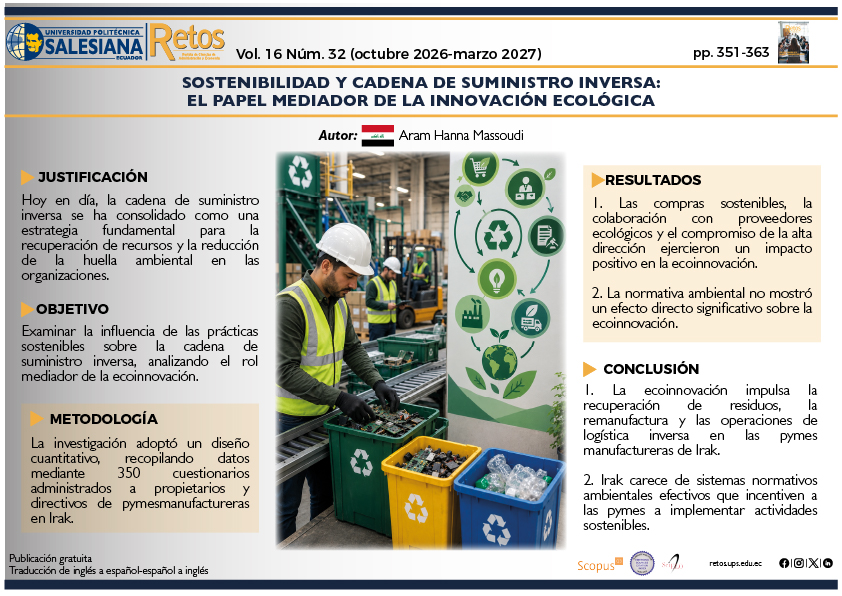
Ante los crecientes obstáculos que plantea la gestión de residuos y la importancia cada vez mayor de la innovación ecológica, las cadenas de suministro inversas se están convirtiendo en una estrategia para que las organizaciones recuperen recursos, generen valor y reduzcan su huella medioambiental. Este estudio examina la influencia de prácticas sostenibles —como las compras sostenibles, la colaboración con proveedores ecológicos, el compromiso de la dirección y la normativa medioambiental— en la cadena de suministro inversa, con la mediación de la innovación ecológica en las pequeñas y medianas empresas iraquíes. El estudio adoptó un diseño cuantitativo y los datos se recopilaron a partir de 350 cuestionarios enviados a propietarios y directivos de empresas manufactureras en Irak. El autor empleó el modelo PLS-SEM para analizar la relación entre las variables. Los resultados muestran que la contratación pública sostenible, la colaboración con proveedores ecológicos y el compromiso de la alta dirección influyeron positivamente en la innovación ecológica. Por el contrario, la normativa medioambiental no tiene ningún efecto directo sobre la innovación ecológica. Este resultado puede explicarse por la débil aplicación de la normativa medioambiental en Irak. Además, la innovación ecológica media la relación entre las compras, la colaboración con proveedores ecológicos, el compromiso de la alta dirección y la cadena de suministro inversa. Esta investigación muestra cómo la innovación ecológica actúa como puente interno que transforma las prácticas generales de sostenibilidad en operaciones concretas y eficientes de la cadena de suministro inversa, abordando así un vacío en la investigación sobre el sector manufacturero y la logística.
Detalles del artículo

Esta obra está bajo una licencia internacional Creative Commons Atribución-NoComercial-CompartirIgual 4.0.
Autoría: La lista de autores firmantes debe incluir únicamente a aquellas personas que hayan contribuido intelectualmente al desarrollo del trabajo. La colaboración en la recogida de datos no es, por sí misma, criterio suficiente de autoría. "Retos" declina toda responsabilidad por posibles conflictos derivados de la autoría de los trabajos que se publiquen.
Derechos de autor: La Universidad Politécnica Salesiana preserva los derechos de autor de los artículos publicados, y favorece y permite su reutilización bajo la licencia Creative Commons Attribution-NonCommercial-ShareAlike 3.0 Ecuador. Pueden ser copiados, utilizados, difundidos, transmitidos y expuestos públicamente, siempre y cuando: i) se cite la autoría y la fuente original de su publicación (revista, editorial y URL del trabajo); (Ii) no se utilicen con fines comerciales; Iii) se mencione la existencia y especificaciones de esta licencia.
Referencias
Al Halbusi, H., Klobas, J. E. y Ramayah, T. (2023). Green core competence and firm performance in a post‐conflict country, Iraq. Business Strategy and the Environment, 32(6), 2702-2714. https://doi.org/10.1002/bse.3265
Almusaed, A., Almssad, A., Alasadi, A. y Al-Asadi, F. (2025). Sustainable reimagining of urban habitats: navigating iraq’s housing crisis through socio-technological and environmental approaches. Ain Shams Engineering Journal, 16(2), 103280. https://doi.org/10.1016/j.asej.2025.103280
Anandhabalaji, V. (2025). Mapping reverse logistics: research insights, environmental impacts, and pathways to sustainability. Transport Economics and Management, 3, 403-422. https://doi.org/10.1016/j.team.2025.10.002
Awewomom, J., Dzeble, F., Takyi, Y. D., Ashie, W. B., Ettey, E. N. Y. O., Afua, P. E., Sackey, L.N., Opoku, F. y Akoto, O. (2024). Addressing global environmental pollution using environmental control techniques: a focus on environmental policy and preventive environmental management. Discover Environment, 2(1), 8-20. https://doi.org/10.1007/s44274-024-00033-5
Bhatti, S. H., Rashid, M., Arslan, A., Tarba, S. y Liu, Y. (2023). Servitized SMEs’ performance and the influences of sustainable procurement, packaging, and distribution: The mediating role of eco-innovation. Technovation, 127, 102831. https://doi.org/10.1016/j.technovation.2023.102831
Buzzao, G. y Rizzi, F. (2021). On the conceptualization and measurement of dynamic capabilities for sustainability: Building theory through a systematic literature review. Business Strategy and the Environment, 30(1), 135-175. https://doi.org/10.1002/bse.2614
Carter, C. R. y Rogers, D. S. (2008). A framework of sustainable supply chain management: Moving toward new theory. International Journal of Physical Distribution & Logistics Management, 38(5), 360–387. https://doi.org/10.1108/09600030810882816
Chai, J., Qian, Z., Wang, F. y Zhu, J. (2024). Process innovation for green product in a closed loop supply chain with remanufacturing. Annals of Operations Research, 333(2), 533-557. https://doi.org/10.1007/s10479-020-03888-y
Chiou, T. Y., Chan, H. K., Lettice, F. y Chung, S. H. (2011). The influence of greening the suppliers and green innovation on environmental performance and competitive advantage in Taiwan. Transportation Research Part E: Logistics and Transportation Review, 47(6), 822-836. https://doi.org/10.1016/j.tre.2011.05.016
Dash, G. y Paul, J. (2021). CB-SEM vs PLS-SEM methods for research in social sciences and technology forecasting. Technological forecasting and social change, 173, 121092. https://doi.org/10.1016/j.techfore.2021.121092
Fernando, Y., Shaharudin, M. S. y Abideen, A. Z. (2023). Circular economy-based reverse logistics: dynamic interplay between sustainable resource commitment and financial performance. European Journal of Management and Business Economics, 32(1), 91-112. https://doi.org/10.1108/EJMBE-08-2020-0254
Govindan, K., Soleimani, H. y Kannan, D. (2015). Reverse logistics and closed-loop supply chain: A comprehensive review to explore the future. European Journal of Operational Research, 240(3), 603-626. https://doi.org/10.1016/j.ejor.2014.07.012
Hair, J. F., Risher, J. J., Sarstedt, M. y Ringle, C. M. (2019). When to use and how to report the results of PLS-SEM. European Business Review, 31(1), 2-24. https://doi.org/10.1108/EBR-11-2018-0203
Hair Jr, J. F., Hult, G. T. M., Ringle, C. M., Sarstedt, M., Danks, N. P. y Ray, S. (2021). Evaluation of reflective measurement models. In Partial least squares structural equation modeling (PLS-SEM) using R: A workbook (pp. 75-90). Springer International Publishing.
Hair Jr, J., Hair Jr, J. F., Sarstedt, M., Ringle, C. M. y Gudergan, S. P. (2023). Advanced issues in partial least squares structural equation modeling. Sage publications.
Haldorai, K., Kim, W. G. y Phetvaroon, K. (2025). Top management commitment, institutional pressures and green supply chain practices: pathways to sustainable performance. Journal of Hospitality and Tourism Insights, 8(8), 2860-2879. https://doi.org/10.1108/JHTI-07-2024-0773
Hariyani, D., Hariyani, P., Mishra, S. y Sharma, M. K. (2024). A literature review on green supply chain management for sustainable sourcing and distribution. Waste Management Bulletin, 2(4), 231-248. https://doi.org/10.1016/j.wmb.2024.11.009
Hart, S. L. (1995). A natural-resource-based view of the firm. Academy of Management Review, 20(4), 986-1014. https://doi.org/10.5465/amr.1995.9512280033
He, C. (2026). Collaborative innovation in product recycling and remanufacturing within the context of a circular supply chain. International Journal of Materials and Product Technology, 70(5), 96-119. https://doi.org/10.1504/IJMPT.2026.10078032
Herzallah, A. M., Iriqat, R. A. M., Zaki, K., Khalifa, G. S., Abdelfadel, T. A. A., Hamed, M. H. y Elnagar, A. K. (2025). Sustainable innovation as a catalyst: linking green supply chain practices to corporate reputation in emerging markets. Cleaner Logistics and Supply Chain, 100245. https://doi.org/10.1016/j.clscn.2025.100245
International Organization for Migration. (2026). Investment readiness baseline study: Iraq. ReliefWeb. https://bit.ly/4gyXEVj
Horbach, J. (2008). Determinants of environmental innovation: New evidence from German panel data sources. Research Policy, 37(1), 163-173. https://doi.org/10.1016/j.respol.2007.08.006
Kawa, A. y Dujak, D. (2025). The impact of logistics requirements and adjustments on firm performance: evidence from wood biomass supply chains. Cleaner Logistics and Supply Chain, 16, 100243. https://doi.org/10.1016/j.clscn.2025.100243
Khaghaany, M., Shaker, A. S., Dawood, A. N. y Almagtome, A. H. (2024). Sustainability, innovation, and value creation in developing countries: evidence from Iraq. Innovar, 34(94), 1-23. https://doi.org/10.15446/innovar.v34n94.116817
Letunovska, N., Offei, F. A., Junior, P. A., Lyulyov, O., Pimonenko, T. y Kwilinski, A. (2023). Green supply chain management: the effect of procurement sustainability on reverse logistics. Logistics, 7(3), 47. https://doi.org/10.3390/logistics7030047
Levi-Bliech, M. y Dahan, G. (2025). The impact of green innovation products on an organization’s social performance via green supply chain management. Green Technologies and Sustainability, 100273. https://doi.org/10.1016/j.grets.2025.100273
Massoudi, A., Zaidan, M., Agha, A. M. Q. y Salahaldin, S. (2026). Organizational constructs influencing sme performance: the mediating role of supply chain resilience. Revista Administração em Diálogo - RAD, 28(1), 46-62. https://doi.org/10.23925/2178-0080.2026v28i1.69200
Massoudi, A.H. & Ahmed, M.E. (2021). Assessing the sustainability of facilities management in the food sector in Kurdistan Region of Iraq. Cihan University-Erbil Journal of Humanities and Social Sciences, 5(1), 106-110. https://doi.org/10.24086/cuejhss.v5n1y2021.pp106-110
Mbago, M., Ntayi, J. M., Mkansi, M., Namagembe, S., Tukamuhabwa, B. R. y Mwelu, N. (2025). Implementing reverse logistics practices in the supply chain: a case study analysis of recycling firms. Modern Supply Chain Research and Applications, 7(2), 200-227. https://doi.org/10.1108/MSCRA-01-2025-0003
Mugoni, E., Nyagadza, B. y Hove, P. K. (2023). Green reverse logistics technology impact on agricultural entrepreneurial marketing firms’ operational efficiency and sustainable competitive advantage. Sustainable Technology and Entrepreneurship, 2(2), 100034. https://doi.org/10.1016/j.stae.2022.100034
Podsakoff, P. M., MacKenzie, S. B., Lee, J.-Y. y Podsakoff, N. P. (2003). Common method biases in behavioral research: A critical review of the literature and recommended remedies. Journal of Applied Psychology, 88(5), 879-903. https://doi.org/10.1037/0021-9010.88.5.879
Porter, M. E. y Van der Linde, C. (1995). Toward a new conception of the environment-competitiveness relationship. Journal of Economic Perspectives, 9(4), 97-118. https://doi.org/10.1257/jep.9.4.97
Richter, N. F. y Tudoran, A. A. (2024). Elevating theoretical insight and predictive accuracy in business research: Combining PLS-SEM and selected machine learning algorithms. Journal of Business Research, 173, 114453.
Safdar, N., Moazzam, M., Ahmed, W., Khan, A. S., Manzoor, W. y Raziq, M. M. (2026). The impact of adopting green procurement practices on the competitiveness of small and medium enterprises: a dual-mediation model. Benchmarking: An International Journal, 33(1), 105-128. https://doi.org/10.1108/BIJ-04-2024-0297
Santos, A., Coelho, A. y Neves, M. E. (2026). The role of green alliance capabilities in supply chain integration and sustainable performance: moderating effects of ambidexterity. Supply Chain Management: An International Journal, 31(2), 190-208. https://doi.org/10.1108/SCM-07-2025-0668
Sataloff, R. T. y Vontela, S. (2021). Response rates in survey research. Journal of Voice, 35(5), 683-684. https://doi.org/10.1016/j.jvoice.2020.12.043
Singh, P. y Anthonysamy, L. (2025). Development and validation of an instrument to assess instructors’ usage, acceptance, and confidence towards ChatGPT: a reliability and discriminant validity analysis. Education and Information Technologies, 30(17), 25251-25271. https://doi.org/10.1007/s10639-025-13773-5
Singh, S. K., Del Giudice, M., Chierici, R. y Graziano, D. (2020). Green innovation and environmental performance: The role of green transformational leadership and green human resource management. Technological Forecasting and Social Change, 150, 119762. https://doi.org/10.1016/j.techfore.2019.119762
Soykoth, M. W., Rahaman, M. M., Hossain, M. A. y Alam, M. J. (2022). Green supply chain and customer satisfaction in modern retailing: a dual-perception analysis with SEM approach. International Journal of Integrated Supply Management, 15(4), 381-409.
Sulemana, I., Cheng, L., Agyemang, A. O., Osei, A. y Nagriwum, T. M. (2025). Stakeholders and sustainability disclosure: Evidence from an emerging market. Sustainable Futures, 9, 100445. https://doi.org/10.1016/j.sftr.2025.100445
Sun, G., Sulemana, I. y Agyemang, A. O. (2025). Examining the impact of stakeholders' pressures on sustainability practices. Management Decision, 63(11), 3967-3995. https://doi.org/10.1108/MD-06-2023-1008
Vachon, S. y Klassen, R. D. (2008). Environmental management and manufacturing performance: The role of collaboration in the supply chain. International Journal of Production Economics, 111(2), 299–315. https://doi.org/10.1016/j.ijpe.2006.11.030
Vimal, K. E. K., Kandasamy, J., Joshi, P., Kokare, A., Kharat, H. y Rajak, S. (2026). Trade off model for optimal sustainability and resilience through circular economy. Annals of Operations Research, 359(2), 2015-2048. https://doi.org/10.1007/s10479-024-06178-0.
Wu, J. (2022). Sustainable development of green reverse logistics based on blockchain. Energy Reports, 8, 11547-11553. https://doi.org/10.1016/j.egyr.2022.08.219
Zhu, Q., Sarkis, J. y Lai, K. H. (2008). Confirmation of a measurement model for green supply chain management practices implementation. International Journal of Production Economics, 111(2), 261-273. https://doi.org/10.1016/j.ijpe.2006.11.029