

Liderazgo innovador sostenible y desempeño en sostenibilidad: FinTech, finanzas verdes y gobernanza de TI
Barra lateral del artículo
Contenido principal del artículo
Resumen
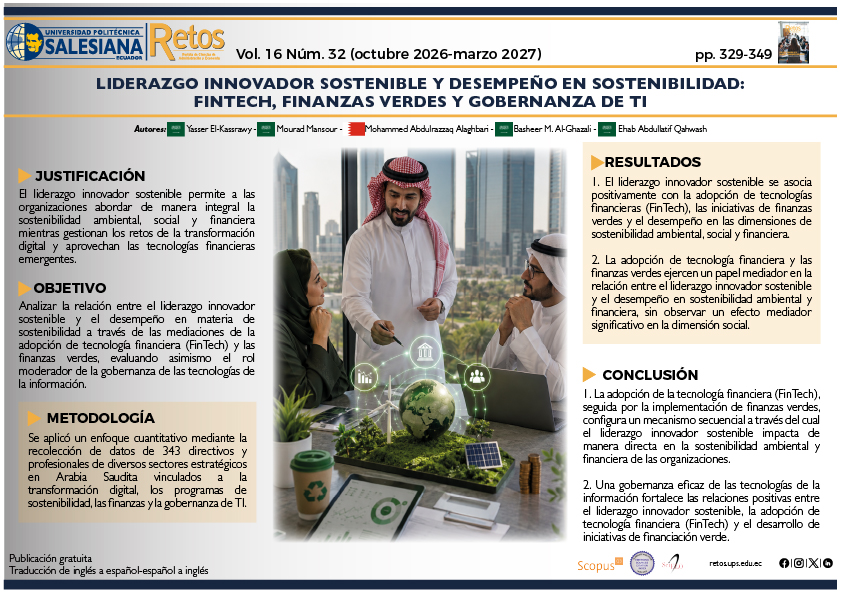
Este estudio examina la relación entre el liderazgo innovador sostenible y el desempeño en sostenibilidad social, ambiental y financiera, considerando los efectos mediadores de la adopción de FinTech y las iniciativas de finanzas verdes, así como el papel moderador de la gobernanza de las tecnologías de la información (TI). Los datos se recopilaron de 343 empleados de nivel directivo pertenecientes a múltiples sectores industriales en Arabia Saudita, quienes participan activamente en iniciativas de transformación digital, programas de sostenibilidad, prácticas de finanzas verdes y procesos de implementación de gobernanza de TI. Los resultados muestran que el liderazgo innovador sostenible se relaciona positivamente con la adopción de FinTech, las iniciativas de finanzas verdes y las tres dimensiones del desempeño en sostenibilidad. La adopción de FinTech y las finanzas verdes median significativamente las relaciones entre el liderazgo innovador sostenible y el desempeño en sostenibilidad ambiental y financiera; sin embargo, las relaciones indirectas correspondientes con el desempeño en sostenibilidad social no resultan estadísticamente significativas. Asimismo, los resultados respaldan una relación indirecta secuencial en la que el liderazgo innovador sostenible se relaciona con el desempeño en sostenibilidad ambiental y financiera mediante la adopción de FinTech y, posteriormente, las finanzas verdes. Además, la gobernanza de TI modera positivamente las relaciones del liderazgo innovador sostenible con la adopción de FinTech y las iniciativas de finanzas verdes. Este estudio contribuye a la literatura sobre sostenibilidad y liderazgo al proponer un marco integrado que explica cómo el liderazgo innovador sostenible se relaciona con el desempeño en sostenibilidad mediante los efectos mediadores de la adopción de FinTech y las iniciativas de finanzas verdes, así como el papel moderador de la gobernanza de TI.
Detalles del artículo

Esta obra está bajo una licencia internacional Creative Commons Atribución-NoComercial-CompartirIgual 4.0.
Autoría: La lista de autores firmantes debe incluir únicamente a aquellas personas que hayan contribuido intelectualmente al desarrollo del trabajo. La colaboración en la recogida de datos no es, por sí misma, criterio suficiente de autoría. "Retos" declina toda responsabilidad por posibles conflictos derivados de la autoría de los trabajos que se publiquen.
Derechos de autor: La Universidad Politécnica Salesiana preserva los derechos de autor de los artículos publicados, y favorece y permite su reutilización bajo la licencia Creative Commons Attribution-NonCommercial-ShareAlike 3.0 Ecuador. Pueden ser copiados, utilizados, difundidos, transmitidos y expuestos públicamente, siempre y cuando: i) se cite la autoría y la fuente original de su publicación (revista, editorial y URL del trabajo); (Ii) no se utilicen con fines comerciales; Iii) se mencione la existencia y especificaciones de esta licencia.
Referencias
Abdeldayem, M. y Aldulaimi, S. (2026). Innovative pathways in capital markets: The fusion of behavioural finance and Fintech for strategic investor decision-making. International Journal of Organizational Analysis, 34(3), 818-842. https://doi.org/10.1108/IJOA-01-2025-5193
Almaqtari, F. A., Rehman, S., Nigam, S. y Khan, M. (2025). The impact of board structure, IT governance, and fintech on green finance and sustainability: An integrated model. Strategic Change, 34(2), 337-357. https://doi.org/10.1002/jsc.2623
Aloulou, M., Grati, R., Al-Qudah, A. A. y Al-Okaily, M. (2024). Does FinTech adoption increase the diffusion rate of digital financial inclusion? A study of the banking industry sector. Journal of Financial Reporting and Accounting, 22(2), 289-307. https://doi.org/10.1108/JFRA-05-2023-0224
Aman-Ullah, A., Aziz, A., Mehmood, W., Vafin, A. y Hassan, M. (2024). Innovative leadership and sustainable performance: A moderation study through personality traits. Journal of Applied Research in Higher Education, 16(5), 2126-2139. https://doi.org/10.1108/JARHE-09-2023-0425
Baig, M. H., Xu, J., Shahzad, F. y Ali, R. (2025). Revealing the potential of FinTech innovation through knowledge assets: A study of firm financial performance. International Journal of Innovation Science, 17(3), 650–682. https://doi.org/10.1108/IJIS-09-2023-0204
Bajwa, F. A., Fu, J., Bajwa, I. A. y Alsuhaibany, Y. M. (2025). Financing the future: The role of fintech, leadership, and financial competencies in driving sustainable firm performance. Acta Psychologica, 260, 105449. https://doi.org/10.1016/j.actpsy.2025.105449
Bhuiyan, M. A., Rahman, M. K., Patwary, A. K., Akter, R., Zhang, Q. y Feng, X. (2024). Fintech adoption and environmental performance in banks: Exploring employee efficiency and green initiatives. IEEE Transactions on Engineering Management, 71, 11346-11360. https://doi.org/10.1109/TEM.2024.3415774
Bonsu, M. O. A., Wang, Y., Nartey, P. R. D. y Amala, M. N. (2025). Does the integration of Fintech and green finance enhance sustainability performance in the banking sector? Information technology governance as moderator. Business Strategy and the Environment, 34(8), 9954-9977. https://doi.org/10.1002/bse.70071
Burawat, P. (2019). The relationships among transformational leadership, sustainable leadership, lean manufacturing and sustainability performance in Thai SMEs manufacturing industry. International Journal of Quality & Reliability Management, 36(6), 1014-1036. https://doi.org/10.1108/IJQRM-09-2017-0178
Chueca Vergara, C. y Ferruz Agudo, L. (2021). Fintech and sustainability: Do they affect each other? Sustainability, 13(13), 7012. https://doi.org/10.3390/su13137012
Dhiaf, M. M., Khakan, N., Atayah, O. F., Marashdeh, H. y El Khoury, R. (2024). The role of FinTech for manufacturing efficiency and financial performance: In the era of industry 4.0. Journal of Decision Systems, 33(2), 220–241. https://doi.org/10.1080/12460125.2022.2094527
Dwivedi, P., Alabdooli, J. I. y Dwivedi, R. (2021). Role of FinTech adoption for competitiveness and performance of the bank: A study of banking industry in UAE. International Journal of Global Business and Competitiveness, 16(2), 130-138. https://doi.org/10.1007/s42943-021-00033-9
Feng, Y. y Shen, Q. (2022). How does green credit policy affect total factor productivity at the corporate level in China: The mediating role of debt financing and the moderating role of financial mismatch. Environmental Science and Pollution Research, 29(16), 23237-23248. https://doi.org/10.1007/s11356-021-17521-3
Flori, M., Raulea, E. C. y Raulea, C. (2025). Innovative leadership and sustainability in higher education management. Computers and Education Open,9, 100272. https://doi.org/10.1016/j.caeo.2025.100272
Fu, C., Lu, L. y Pirabi, M. (2023). Advancing green finance: A review of sustainable development. Digital Economy and Sustainable Development, 1(1), 20-37. https://doi.org/10.1007/s44265-023-00020-3
Hidayat-ur-Rehman, I. y Hossain, M. N. (2025). The impacts of Fintech adoption, green finance and competitiveness on banks’ sustainable performance: Digital transformation as moderator. Asia-Pacific Journal of Business Administration, 17(4), 987-1020. https://doi.org/10.1108/APJBA-10-2023-0497
Hossain, M. N., Hidayat-ur-Rehman, I., Bhuiyan, A. B. y Salleh, H. M. (2026). Evaluating the influence of IT governance, fintech adoption, and financial literacy on sustainable performance. Studies in Economics and Finance, 43(3), 811-835. https://doi.org/10.1108/SEF-10-2024-0672
Huo, C., Safdar, M. A. y Ahmed, M. (2024). Impact of responsible leadership on sustainable performance: A moderated mediation model. Kybernetes, 53(12), 5263–5284. https://doi.org/10.1108/K-03-2023-0342
Hussain, S., Rasheed, A. y Rehman, S. U. (2024). Driving sustainable growth: Exploring the link between financial innovation, green finance and sustainability performance: Banking evidence. Kybernetes, 53(11), 4678–4696. https://doi.org/10.1108/K-05-2023-0918
Jahanger, A., Balsalobre-Lorente, D., Ali, M., Samour, A., Abbas, S., Tursoy, T. y Joof, F. (2024). Going away or going green in ASEAN countries: Testing the impact of green financing and energy on environmental sustainability. Energy & Environment, 35(7), 3759-3784. https://doi.org/10.1177/0958305X231171346
Khan, R. U., Saqib, A., Abbasi, M. A., Mikhaylov, A. y Pinter, G. (2023). Green Leadership, environmental knowledge sharing, and sustainable performance in manufacturing Industry: Application from upper echelon theory. Sustainable Energy Technologies and Assessments, 60. https://doi.org/10.1016/j.seta.2023.103540
Khaw, T. Y., Teoh, A. P., Abdul Khalid, S. N. y Letchmunan, S. (2022). The impact of digital leadership on sustainable performance: A systematic literature review. Journal of Management Development, 41(9-10), 514-534. https://doi.org/10.1108/JMD-03-2022-0070
Kock, N. (2015). Common method bias in PLS-SEM: A full collinearity assessment approach. International Journal of E-Collaboration, 11(4), 1-10. https://doi.org/10.4018/IJeC.2015100101
Lee, I. y Shin, Y. J. (2018). Fintech: Ecosystem, business models, investment decisions, and challenges. Business Horizons, 61(1), 35-46. https://doi.org/10.1016/j.bushor.2017.09.003
Nazir, S., Khadim, S. y Syed, N. (2025). Go where the winners go–examining the impact of sustainable leadership on firms’ sustainable performance through mediation and moderation analysis. Management Research Review, 48(7), 1015–1042. https://doi.org/10.1108/MRR-04-2024-0288
Pizzi, S., Corbo, L. y Caputo, A. (2021). Fintech and SMEs sustainable business models: Reflections and considerations for a circular economy. Journal of Cleaner Production, 281, 125217. https://doi.org/10.1016/j.jclepro.2020.125217
Siddik, A. B., Yong, L. y Rahman, M. N. (2023). The role of Fintech in circular economy practices to improve sustainability performance: A two-staged SEM-ANN approach. Environmental Science and Pollution Research, 30(49), 107465-107486. https://doi.org/10.1007/s11356-023-25576-7
Singh, H. P. y Alhulail, H. N. (2023). Information technology governance and corporate Boards’ Relationship with companies’ performance and earnings management: A longitudinal approach. Sustainability, 15(8), 6492. https://doi.org/10.3390/su15086492
Teece, D. J. (2018). Dynamic capabilities as (workable) management systems theory. Journal of Management & Organization, 24(3), 359-368. https://doi.org/10.1017/jmo.2017.75
Wang, B. y Zhang, K. (2023). Impact of green digital finance on green economic recovery and green agricultural development: Implications for green environment. Environmental Science and Pollution Research, 30(49), 107611-107623. https://doi.org/10.1007/s11356-023-29599-y
Wiengarten, F., Lo, C. K. y Lam, J. Y. (2017). How does sustainability leadership affect firm performance? The choices associated with appointing a chief officer of corporate social responsibility. Journal of Business Ethics, 140(3), 477-493. https://doi.org/10.1007/s10551-015-2666-5
Wu, Y., Mehmood, K., Mangla, S. K. y Jabeen, F. (2026). A dynamic capability view to evaluate the role of FinTech in green supply chain performance: moderating role of data‐driven lean and green practices. Business Strategy and the Environment, 35(4), 5841-5858. https://doi.org/10.1002/bse.70459
Yadegaridehkordi, E., Foroughi, B., Iranmanesh, M., Nilashi, M. y Ghobakhloo, M. (2023). Determinants of environmental, financial, and social sustainable performance of manufacturing SMEs in Malaysia. Sustainable Production and Consumption, 35, 129-140. https://doi.org/10.1016/j.spc.2022.10.026
Yang, Y., Su, X. y Yao, S. (2021). Nexus between green finance, fintech, and high-quality economic development: Empirical evidence from China. Resources Policy, 74. https://doi.org/10.1016/j.resourpol.2021.102445
Zhang, D., Zhang, Z. y Managi, S. (2019). A bibliometric analysis on green finance: Current status, development, and future directions. Finance Research Letters, 29, 425-430. https://doi.org/10.1016/j.frl.2019.02.003
Zhang, T. (2023). Can green finance policies affect corporate financing? Evidence from China’s green finance innovation and reform pilot zones. Journal of Cleaner Production, 419, 138289. https://doi.org/10.1016/j.jclepro.2023.138289
Zhu, W., Yang, H., Yang, B. y Sosik, J. J. (2024). Innovative leadership in organizations: Dimensions, measurement, and validation. Journal of Business Research, 172, 114445. https://doi.org/10.1016/j.jbusres.2023.114445
Zygiaris, S. y Maamari, B. E. (2023). The journey from e-government to digital transformation: The case of Saudi Arabia. Electronic Government, an International Journal, 19(1), 95-111. https://doi.org/10.1504/EG.2023.127578