

Actitud hacia la educación emprendedora e intención emprendedora en programas universitarios depreincubación e incubación en Perú
Barra lateral del artículo
Contenido principal del artículo
Resumen
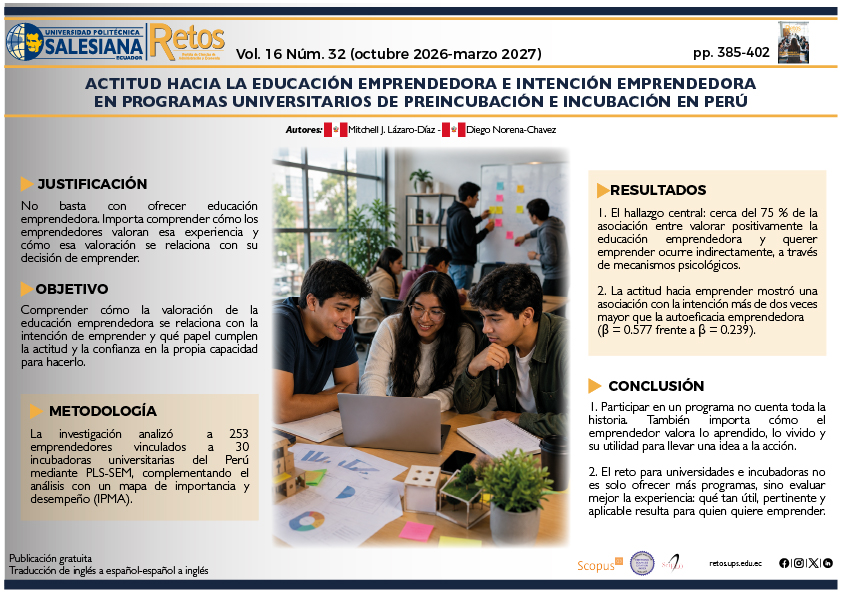
El emprendimiento constituye una vía relevante para la creación de empresas y la ampliación de oportunidades en economías emergentes, donde gobiernos, organismos de apoyo y universidades han ampliado su oferta de educación emprendedora (EE). Sin embargo, la relación entre EE e intención emprendedora (IE) presenta resultados heterogéneos, lo que plantea la necesidad de comprender tanto la participación en programas formativos como la valoración que los participantes atribuyen a la experiencia recibida. El objetivo fue analizar cómo la actitud hacia la educación emprendedora (AEE), entendida como una valoración multidimensional de la experiencia formativa, se asocia con la IE mediante la actitud hacia el emprendimiento (AE) y la autoeficacia emprendedora (AEFE) en 253 emprendedores vinculados a programas universitarios de preincubación e incubación en Perú. El modelo se estimó mediante PLS-SEM y el análisis se complementó con IPMA. Los resultados respaldaron la especificación de la AEE como constructo de orden superior reflectivo-reflectivo, integrado por dimensiones cognitivas, afectivas y conductuales. La asociación entre AEE e IE fue predominantemente indirecta, con mayor magnitud mediante la AE que la AEFE, mostrando una relevancia diferencial de ambos mecanismos psicológicos. El IPMA mostró elevada importancia relativa de la AEE, derivada principalmente de sus efectos indirectos. Los hallazgos extienden el estudio de la AEE a emprendedores en preincubación e incubación y muestran que comprender su relación con la IE requiere considerar cómo se valora multidimensionalmente la experiencia formativa y mediante qué mecanismos psicológicos se relaciona con la intención.
Detalles del artículo

Esta obra está bajo una licencia internacional Creative Commons Atribución-NoComercial-CompartirIgual 4.0.
Autoría: La lista de autores firmantes debe incluir únicamente a aquellas personas que hayan contribuido intelectualmente al desarrollo del trabajo. La colaboración en la recogida de datos no es, por sí misma, criterio suficiente de autoría. "Retos" declina toda responsabilidad por posibles conflictos derivados de la autoría de los trabajos que se publiquen.
Derechos de autor: La Universidad Politécnica Salesiana preserva los derechos de autor de los artículos publicados, y favorece y permite su reutilización bajo la licencia Creative Commons Attribution-NonCommercial-ShareAlike 3.0 Ecuador. Pueden ser copiados, utilizados, difundidos, transmitidos y expuestos públicamente, siempre y cuando: i) se cite la autoría y la fuente original de su publicación (revista, editorial y URL del trabajo); (Ii) no se utilicen con fines comerciales; Iii) se mencione la existencia y especificaciones de esta licencia.
Referencias
Ahmed, T., Klobas, J. E., Chandran, V. G. R., Akhtar, M. W., & Sergi, B. S. (2025). How perceived contextual barriers for entrepreneurship reduce entrepreneurial intentions: a TPB study. International Entrepreneurship and Management Journal, 21(1). https://doi.org/10.1007/s11365-024-01047-4
Ajzen, I. (1991). The theory of planned behavior. Organizational Behavior and Human Decision Processes, 50(2), 179–211. https://doi.org/10.1016/0749-5978(91)90020-T
Al-Qadasi, N., Zhang, G., Al-Jubari, I., Al-Awlaqi, M. A., & Aamer, A. M. (2024). Entrepreneurship education and entrepreneurial behaviour: Do self-efficacy and attitude matter? International Journal of Management Education, 22(1). https://doi.org/10.1016/j.ijme.2024.100945
Bae, T. J., Qian, S., Miao, C., & Fiet, J. O. (2014). The Relationship Between Entrepreneurship Education and Entrepreneurial Intentions: A Meta-Analytic Review. Entrepreneurship: Theory and Practice, 38(2), 217–254. https://doi.org/10.1111/etap.12095
Bandura, A. (1997). Self-efficacy : The Exercise of Control. W.H. Freeman.
Becker, J. M., Klein, K., & Wetzels, M. (2012). Hierarchical Latent Variable Models in PLS-SEM: Guidelines for Using Reflective-Formative Type Models. Long Range Planning, 45(5–6), 359–394. https://doi.org/10.1016/j.lrp.2012.10.001
Estrin, S., Guerrero, M., & Mickiewicz, T. (2024). A framework for investigating new firm entry: The (limited) overlap between informal-formal and necessity-opportunity entrepreneurship. Journal of Business Venturing, 39(4). https://doi.org/10.1016/j.jbusvent.2024.106404
Fayolle, A., & Gailly, B. (2015). The impact of entrepreneurship education on entrepreneurial attitudes and intention: Hysteresis and persistence. Journal of Small Business Management, 53(1), 75–93. https://doi.org/10.1111/jsbm.12065
Ghouse, S. M., Barber, D., & Alipour, K. (2024). Shaping the future Entrepreneurs: Influence of human capital and self-efficacy on entrepreneurial intentions of rural students. International Journal of Management Education, 22(3). https://doi.org/10.1016/j.ijme.2024.101035
Hair, J. F., Tomas, G., Hult, M., Ringle, C. M., & Sarstedt, M. (2021). A Primer on Partial Least Squares Structural Equation Modeling (PLS-SEM) (3rd ed.). Sage. https://www.researchgate.net/publication/354331182
Hamdan, A., Ghura, H., Alareeni, B., & Hamdan, R. K. (2022). Entrepreneurship Growth in Emerging Economies: New Insights and Approaches. In Journal of Sustainable Finance and Investment (Vol. 12, Number 1, pp. 1–12). Taylor and Francis Ltd. https://doi.org/10.1080/20430795.2021.1944750
Henseler, J., Ringle, C. M., & Sarstedt, M. (2015). A new criterion for assessing discriminant validity in variance-based structural equation modeling. Journal of the Academy of Marketing Science, 43(1), 115–135. https://doi.org/10.1007/s11747-014-0403-8
Jena, R. K. (2020). Measuring the impact of business management Student’s attitude towards entrepreneurship education on entrepreneurial intention: A case study. Computers in Human Behavior, 107. https://doi.org/10.1016/j.chb.2020.106275
Kline, R. B. (2023). Principles and Practice of Structural Equation Modeling (5th Ed.). The Guilford publications.
Kock, N. (2015). Common method bias in PLS-SEM: A full collinearity assessment approach. International Journal of E-Collaboration, 11(4), 1–10. https://doi.org/DOI:10.4018/ijec.2015100101
Krueger, N. F., Reilly, M. D., & Carsrud, A. L. (2000). Competing models of entrepreneurial intentions. Journal of Business Venturing, 15(5), 411–432. https://doi.org/10.1016/S0883-9026(98)00033-0
Le, T. T., Doan, X. H., & Duong, C. D. (2023). A serial mediation model of the relation between cultural values, entrepreneurial self-efficacy, intentions and behaviors: Does entrepreneurial education matter? A multi-group analysis. Journal of Open Innovation: Technology, Market, and Complexity, 9(2). https://doi.org/10.1016/j.joitmc.2023.100064
Lim, W. M., Bansal, S., Kumar, S., Singh, S., & Nangia, P. (2024). Necessity entrepreneurship: A journey from unemployment to self-employment. In Global Business and Organizational Excellence (Vol. 43, Number 6, pp. 41–58). John Wiley and Sons Inc. https://doi.org/10.1002/joe.22256
Liñán, F., & Chen, Y.-W. (2009). Development and cross-cultural Application of a Specific Instrument to Measure Entrepreneurial Intentions. Entrepreneurship Theory and Practice, 33(3), 593–617. https://doi.org/https://doi.org/10.1111/j.1540-6520.2009.00318.x
Martínez-Gregorio, S., Badenes-Ribera, L., & Oliver, A. (2021). Effect of entrepreneurship education on entrepreneurship intention and related outcomes in educational contexts: a meta-analysis. International Journal of Management Education, 19(3). https://doi.org/10.1016/j.ijme.2021.100545
McGee, J. E., Peterson, M., Mueller, S. L., & Sequeira, J. M. (2009). Entrepreneurial self-efficacy: Refining the measure. Entrepreneurship: Theory and Practice, 33(4), 965–988. https://doi.org/10.1111/j.1540-6520.2009.00304.x
Montes, J., Ávila, L., Hernández, D., Apodaca, L., Zamora-Bosa, S., & Cordova-Buiza, F. (2023). Impact of entrepreneurship education on the entrepreneurial intention of university students in Latin America. Cogent Business and Management, 10(3). https://doi.org/10.1080/23311975.2023.2282793
Nabi, G., LiñáN, F., Fayolle, A., Krueger, N., & Walmsley, A. (2017). The impact of entrepreneurship education in higher education: A systematic review and research agenda. In Academy of Management Learning and Education (Vol. 16, Number 2, pp. 277–299). George Washington University. https://doi.org/10.5465/amle.2015.0026
Oosterbeek, H., van Praag, M., & Ijsselstein, A. (2010). The impact of entrepreneurship education on entrepreneurship skills and motivation. European Economic Review, 54(3), 442–454. https://doi.org/10.1016/j.euroecorev.2009.08.002
Otache, I. (2025). The links between entrepreneurial education, self-efficacy, attitude and behaviour: A serial mediation model. International Journal of Management Education, 23(2). https://doi.org/10.1016/j.ijme.2025.101146
Otache, I., Edopkolor, J. E., Sani, I. A., & Umar, K. (2024). Entrepreneurship education and entrepreneurial intentions: Do entrepreneurial self-efficacy, alertness and opportunity recognition matter? International Journal of Management Education, 22(1). https://doi.org/10.1016/j.ijme.2023.100917
Piperopoulos, P., & Dimov, D. (2015). Burst Bubbles or Build Steam? Entrepreneurship Education, Entrepreneurial Self-Efficacy, and Entrepreneurial Intentions. Journal of Small Business Management, 53(4), 970–985. https://doi.org/10.1111/jsbm.12116
Ringle, C. M., & Sarstedt, M. (2016). Gain more insight from your PLS-SEM results the importance-performance map analysis. In Industrial Management and Data Systems (Vol. 116, Number 9, pp. 1865–1886). Emerald Group Publishing Ltd. https://doi.org/10.1108/IMDS-10-2015-0449
Sarstedt, M., Hair, J. F., Cheah, J. H., Becker, J. M., & Ringle, C. M. (2019). How to specify, estimate, and validate higher-order constructs in PLS-SEM. Australasian Marketing Journal, 27(3), 197–211. https://doi.org/10.1016/j.ausmj.2019.05.003
Serpente, G., Bolzani, D., & Grimaldi, R. (2025). Entrepreneurial support organizations as providers of entrepreneurial education and training. In Journal of Technology Transfer (Vol. 50, Number 5, pp. 2412–2442). Springer. https://doi.org/10.1007/s10961-024-10177-4
Silesky-Gonzalez, E., Lezcano-Calderon, Y., & Mora-Cruz, A. (2025). Effects of education for entrepreneurship and entrepreneurial intention in university students. International Entrepreneurship and Management Journal, 21(1). https://doi.org/10.1007/s11365-024-01039-4
Tchokoté, I. D., Bawack, R., & Nana, A. (2025). Attitude over norms: Reevaluating the dominance of attitude in shaping entrepreneurial intentions among higher education students in Global South Countries. International Journal of Management Education, 23(2). https://doi.org/10.1016/j.ijme.2024.101129
Thompson, E. R. (2009). Individual entrepreneurial intent: Construct clarification and development of an internationally reliable metric. Entrepreneurship: Theory and Practice, 33(3), 669–694. https://doi.org/10.1111/j.1540-6520.2009.00321.x
Tiberius, V., & Weyland, M. (2023). Entrepreneurship education or entrepreneurship education? A bibliometric analysis. Journal of Further and Higher Education, 47(1), 134–149. https://doi.org/10.1080/0309877X.2022.2100692
Wu, X., & Tian, Y. (2022). Predictors of Entrepreneurship Intention Among Students in Vocational Colleges: A Structural Equation Modeling Approach. Frontiers in Psychology, 12. https://doi.org/10.3389/fpsyg.2021.797790
Wudhikarn, R., Anantana, T., Phongthiya, T., Paphawasit, B., & Pattanasak, P. (2025). Developing an intellectual capital benchmarking approach of business incubators. Journal of Intellectual Capital. https://doi.org/10.1108/JIC-09-2024-0285
Ying, L., & Yaakob, M. F. M. (2025). Mediation effect of entrepreneurial attitude between entrepreneurship education and entrepreneurial self-efficacy on entrepreneurial intention evidence from Chinese higher vocational education institutions. Discover Sustainability, 6(1). https://doi.org/10.1007/s43621-025-01452-x
Yousaf, U., Ali, S. A., Ahmed, M., Usman, B., & Sameer, I. (2021). From entrepreneurial education to entrepreneurial intention: a sequential mediation of self-efficacy and entrepreneurial attitude. International Journal of Innovation Science, 13(3), 364–380. https://doi.org/10.1108/IJIS-09-2020-0133
Zhao, H., Seibert, S. E., & Hills, G. E. (2005). The mediating role of self-efficacy in the development of entrepreneurial intentions. Journal of Applied Psychology, 90(6), 1265–1272. https://doi.org/10.1037/0021-9010.90.6.1265