

Llamado a contribuciones. Retos Nº 33 (Abril 2027)
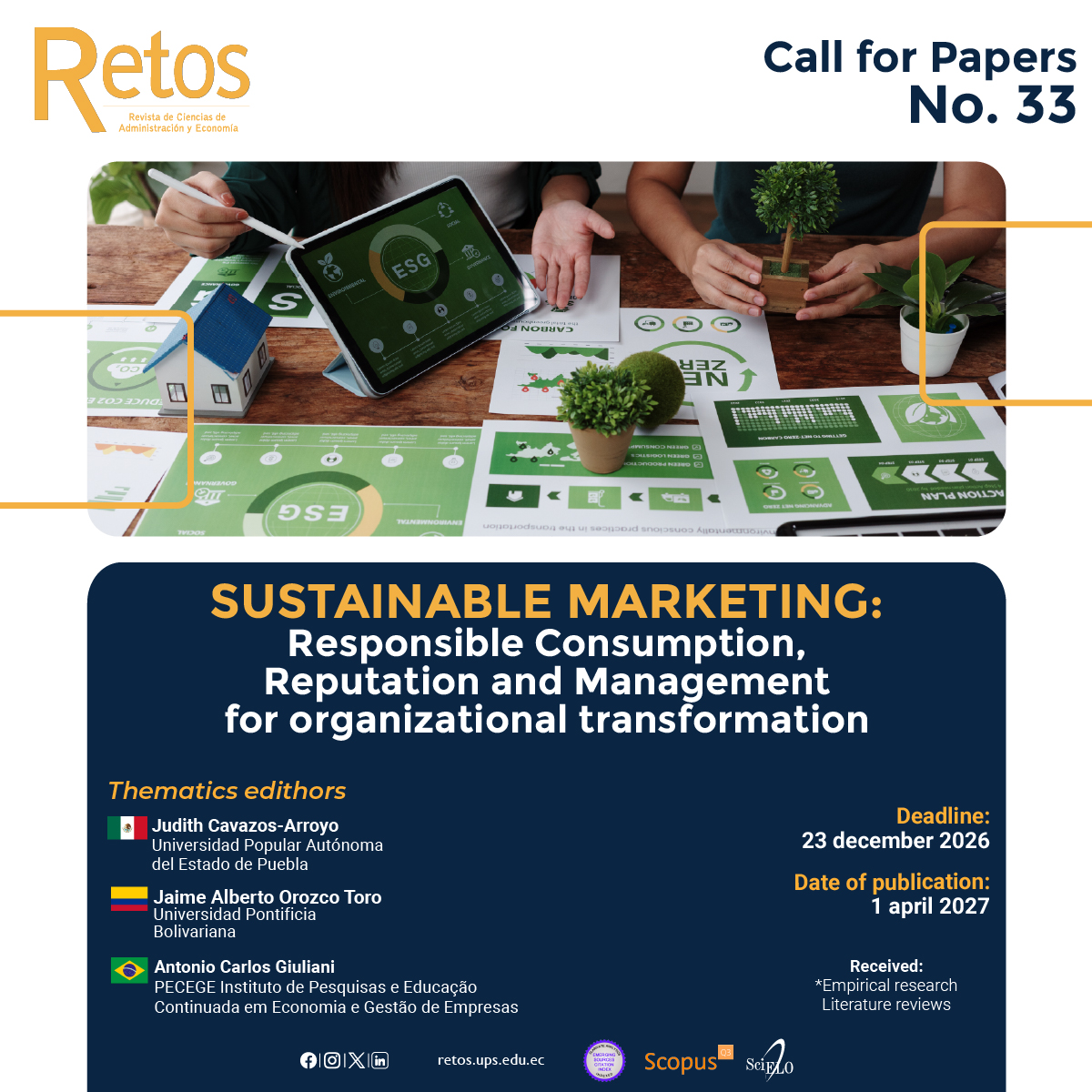
Posted on 2026-07-01Sustainable Marketing: Responsible Consumption, Reputation, and Management for Organizational Transformation
Judith Cavazos-Arroyo
Universidad Popular Autónoma del Estado de Puebla, México
ORCID: https://orcid.org/0000-0002-6258-289X
Jaime Alberto Orozco Toro
Universidad Pontificia Bolivariana, Colombia
ORCID: https://orcid.org/0000-0002-8152-7474
Antonio Carlos Giuliani
PECEGE Instituto de Pesquisas e Educação Continuada em Economia e Gestão de Empresas, Brazil
ORCID: https://orcid.org/0000-0002-9867-8164
The growing concern for global sustainability has driven debates and actions across multiple sectors, positioning marketing as a key player both in problematizing socio-environmental challenges and in seeking innovative solutions (White et al., 2025). In this context, organizations face the challenge of integrating sustainable marketing strategies that balance their socio-environmental responsibilities with value creation for their stakeholders. Both in physical and digital environments, these strategies have become a decisive axis for influencing audience behavior, strengthening relationships with stakeholders, and promoting responsible consumption practices. Initiatives such as sustainable organizational practices, the development of environmentally responsible products, and building trustworthy brands committed to sustainable development allow for the transformation of organizational ecosystems and contribute to a culture oriented toward social and environmental well-being (Monfort et al., 2025; Rosário, 2025; Sharma et al., 2026).
Although sustainable marketing initially focused on resource conservation and green marketing, its scope has expanded to encompass topics such as the circular economy, anti-consumption, regulatory frameworks, consumer sovereignty, degrowth and the culture of limits, internal branding, corporate social responsibility, innovation, carbon emissions, sustainable business models, digital social transformation, governance, sustainable brand management, and the ethical dimensions inherent to this line of research (Lloveras & Pansera, 2026; White et al., 2025).
Thus, this special issue invites the academic community to deepen the understanding of sustainable marketing through empirical quantitative research and to advance the theoretical and methodological development of the field, while inspiring management professionals to explore solutions that contribute to a more sustainable future.
The call for contributions aims to: advance knowledge of sustainable marketing through quantitative studies analyzing how efforts toward responsible consumption, reputation building, and marketing strategies oriented toward organizational transformation drive practices and models that coherently integrate sustainability into processes.
The call prioritizes empirical research, featuring:
- Quantitative approaches
- Rigorous methodological designs
- Representative samples
- Robust statistical analyses
Suggested Topics
Manuscripts may address, among others:
- Organizational transformation toward sustainability driven by sustainable marketing approaches
- Sustainable business models, governance, and transparency
- Digitalization and sustainability in public, private, and NGO sectors
- Circular economy and responsible consumption
- Responsible consumption practices, consumption reduction, and the culture of limits
- Consumer sovereignty and regulatory frameworks
- Sustainable innovation and responsible product development
- Emission mitigation strategies and environmental communication
- Organizational and brand reputation
Submission Requirements
Authors must comply with the checklist established by the journal, which includes:
- Manuscript originality
- Absence of duplication or previous publication
- Declaration of veracity of data and sources
- Declaration of conflicts of interest
- Use of the official template
- File in Word or OpenOffice format
- Submission of a cover letter
- Removal of authorship data within the manuscript (double-blind)
Important Dates
Deadline for paper submission: December 23, 2026.
Publication of the issue: April 1, 2027.
References
Lloveras, J., & Pansera, M. (2026). Degrowth: a literature review and conceptualisation for sustainable marketing and consumer research. Journal of Marketing Management, 42 (5-6), 644–674. https://doi.org/10.1080/0267257X.2025.2572966
Longo, C., & Regany, F. (2026). Community internal activism for CSR brand repositioning. Journal of Product & Brand Management, 35 (3), 448–463. https://doi.org/10.1108/JPBM-07-2024-5328
Rosário, A. T., & Dias, J. C. (2025). The Role of Digital Marketing in Shaping Sustainable Consumption: Insights from a Systematic Literature Review. Sustainability, 17 (17), 7784. https://doi.org/10.3390/su17177784
Sharma, D., Soodan, V., & Chakraborty, S. (2026). The Economics of Sustainability: Role of Green Marketing in Promoting Brand Reputation. In Trikha, A., Kaushik, M. B., Gowri, D. P., Dahiya, K., & Gulati, G. (Eds.). Green To Gold: Marketing Strategies for a Sustainable Future (pp. 357-376). Cham: Springer Nature Switzerland. https://doi.org/10.1007/978-3-032-10212-6_17
Monfort, A., López-Vázquez, B., & Sebastián-Morillas, A. (2025). Building trust in sustainable brands: Revisiting perceived value, satisfaction, customer service, and brand image. Sustainable Technology and Entrepreneurship, 4 (3), 100105. https://doi.org/10.1016/j.stae.2025.10010
White, K., Cakanlar, A., Sethi, S., & Trudel, R. (2025). The past, present, and future of sustainability marketing: how did we get here and where might we go?. Journal of Business Research, 187, 115056. https://doi.org/10.1016/j.jbusres.2024.115056