

Estimating accounting operating performance in business sectors in Ecuador: adaptation of the CAPM Model
Article Sidebar
Main Article Content
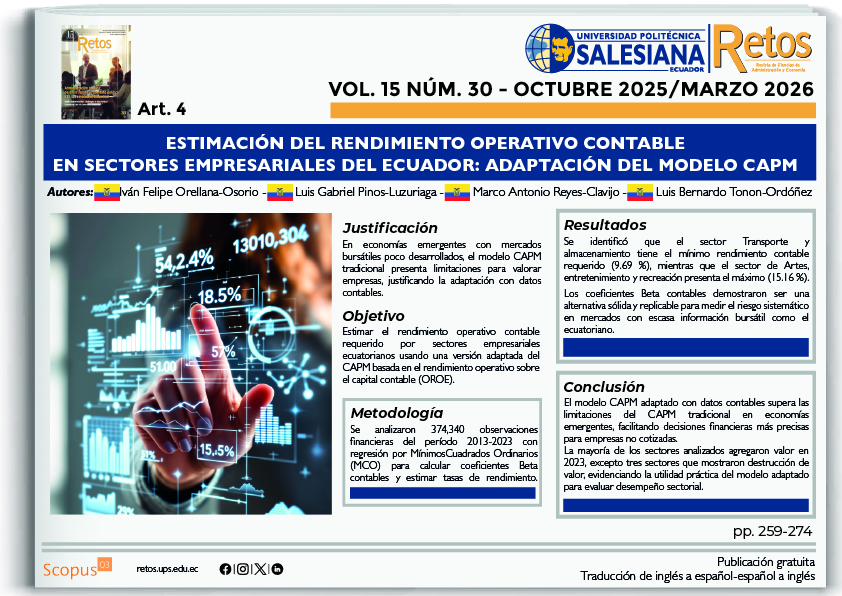
Abstract
in countries with economies characterized by underdeveloped financial markets and limited availability of stock market information,
the traditional CAPM model presents limitations in its application, making it difficult to value companies in this environment. The objective of
this research was to estimate the expected accounting operating performance for different Ecuadorian business sectors, using an adaptation of
the CAPM model based on accounting data, specifically the operating return on equity (OROE). To this end, a series of historical data taken from
the Superintendency of Companies, Securities and Insurance database for the period 2013-2023 was analyzed. The sample consisted of 374,340
observations. Estimates were made using the Ordinary Least Squares (OLS) method, obtaining the following results for the Required Accounting
Return values, locating the minimum value of 9.69% in the Transportation and Storage sector, compared to the Arts, Entertainment and Recreation
sector, which presented the maximum value of 15.16%. The work concluded that, in the case of Ecuador, the use of accounting data and accounting
Beta emerge as an alternative to traditional models. This generates a more precise way to analyze the balance between risk and return in the
financial decisions of unlisted companies, providing a replicable methodology in economies with similar contexts.
Article Details

This work is licensed under a Creative Commons Attribution-NonCommercial-ShareAlike 4.0 International License.
Authorship: The list of authors signing must include only those people who have contributed intellectually to the development of the work. Collaboration in the collection of data is not, by itself, a sufficient criterion of authorship. "Retos" declines any responsibility for possible conflicts arising from the authorship of the works that are published.
Copyright: The Salesian Polytechnic University preserves the copyrights of the published articles, and favors and allows their reuse under the Creative Commons Attribution-NonCommercial-ShareAlike 3.0 Ecuador license. They may be copied, used, disseminated, transmitted and publicly displayed, provided that: i) the authorship and the original source of their publication (journal, editorial and work URL) are cited; (Ii) are not used for commercial purposes; Iii) mention the existence and specifications of this license.
References
Aguilar, A. (2017). Las Betas calculadas, los dilemas en su uso y el impacto en el CAPM. Quipukamayoc, 25(47), 123. https://doi.org/10.15381/quipu.v25i47.13810
Arcas, M. (1991). Estudio de la asociación entre el riesgo sistemático del mercado y determinadas variables contables. Revista Española de Financiación y Contabilidad, 20(66), 127–150. http://www.jstor.org/stable/42780081
Azofra, V., Rodríguez, J., & Vallelado, E. (1997). Determinantes del riesgo de las empresas industriales españolas. Revista Española de Financiación y Contabilidad, 26(92), 749–775. https://www.jstor.org/stable/42780440
Ball, R., Kothari, S., & Watts, R. (1993). Economic Determinants of the Relation between Earnings Changes and Stock Returns. The Accounting Review, 68(3), 622–638. http://www.jstor.org/stable/248205
Beaver, W., Kettler, P., & Scholes, M. (1970). The Association between Market Determined and Accounting Determined Risk Measures. The Accounting Review, 45(4), 654–682. http://www.jstor.org/stable/244204
Beaver, W., & Manegold, J. The association between market-determined and accounting- determined measures of systematic risk: some further evidence. Journal of Financial and Quantitative Analysis, 10(2), 231-284. https://doi.org/10.2307/2979035
Bedoui, R., & BenMabrouk, H. (2017). CAPM with various utility functions: Theoretical developments and application to international data. Cogent Economics and Finance, 5(1), 1–21. https://doi.org/10.1080/23322039.2017.1343230
Bildersee, J. (1975). The Association between a Market-Determined Measure of Risk and Alternative Measures of Risk. The Accounting Review, 50(1), 81–98. http://www.jstor.org/stable/244665
Bowman, R. (1979). The Theoretical Relationship Between Systematic Risk and Financial (Accounting) Variables. The Journal of Finance, 34(3), 617–630. https://doi.org/10.2307/2327430
Breen, W., & Lerner, E. (1973). Corporate Financial Strategies and Market Measures of Risk and Return. The Journal of Finance, 28(2), 339–351. https://doi.org/10.2307/2978306
Brimble, M., & Hodgson, A. (2007), Assessing the risk relevance of accounting variables in diverse economic conditions. Managerial Finance, 33(8), 553-573. https://doi.org/10.1108/03074350710760296
Caicedo, A. (2022). Relación entre el impuesto de renta y la rentabilidad sobre el patrimonio en las empresas colombianas periodo 2016 a 2019. Equidad y Desarrollo, 1(38), 5–6. https://doi.org/10.19052/eq.vol1.iss38.3
De Sousa, F. (2013). Modelo de valoración de activos financieros (CAPM) y teoría de valoración por arbitraje (APT): Un test empírico en las empresas del sector eléctrico brasileño. Cuadernos de Contabilidad, 14, 731–746. http://www.scielo.org.co/pdf/cuco/v14n35/v14n35a14.pdf
Ecker, F., Francis, J., Olsson, P., & Schipper, K. (2009). A comparison of market-based and accounting-based descriptions of business risk. Working Paper. Duke University.
Elgers, P. (1980). Accounting-Based Risk Predictions: A Re-Examination. The Accounting Review, 55(3), 389–408. http://www.jstor.org/stable/246403
Faiteh, A., & Aasri, M. (2022). Accounting Beta as an Indicator of Risk Measurement: The Case of the Casablanca Stock Exchange. Risks, 10(8). https://doi.org/10.3390/risks10080149
Gambi, A., Siqueira, I., & Pimenta, T. (2014). Informação contábil e beta de mercado. Revista Universo Contábil, 10(4), 128–143. https://doi.org/10.4270/ruc.2014433
Gitman, L., & Zutter, C. (2016). Principios de Administración Financiera (14th ed.). Pearson Educación.
Gonedes, N. (1973). Evidence on the Information Content of Accounting Numbers: Accounting-Based and Market-Based Estimates of Systematic Risk. The Journal of Financial and Quantitative Analysis, 8(3). https://doi.org/10.2307/2329643
Gujarati, D., & Porter, D. (2009). Basic Econometrics (5th ed.). McGraw-Hill/Irwin.
Hamada, R. (1972). The Effect of the Firm’s Capital Structure on the Systematic Risk of Common Stocks. Source: The Journal of Finance, 27(2), 435–452. https://doi.org/10.2307/2978486
Hill, N., & Stone, B. (1980). Accounting Betas, Systematic Operating Risk, and Financial Leverage: A Risk-Composition Approach to the Determinants of Systematic Risk. The Journal of Financial and Quantitative Analysis, 15(3), 595–637. https://doi.org/10.2307/2330401
Isaac, D., Caicedo, A, Cortés, J., de la Oliva, F., & Bravo, W. (2024). Comparison of fixed effects and random effects panel models for the estimation of accounting Beta coefficient. Revista Digital Operacional, 45(3), 282–293. https://rev-inv-ope.pantheonsorbonne.fr/sites/default/files/inline-files/45324-03.pdf
Isaac, D., Muñoz, A., Escobar, J., & de la Oliva, F. (2021). The use of accounting beta as a risk assessment method for unlisted companies in Colombia. Universidad y Sociedad, 13(2), 23–30. http://scielo.sld.cu/scielo.php?script=sci_arttext&pid=S2218-36202021000200023&lang=es
Karels, G., & Sackley, W. (1993). The relationship between market and accounting betas for commercial banks. Review of Financial Economics, 2, 59-72. https://doi.org/10.1002/j.1873-5924.1993.tb00565.x
Laveren, E., Durinck, E., De Ceuster, M., & Lybaert, N. (1997). Can accounting variables explain any beta? The empirical association between various betas and nine accounting variables in Belgian listed firms. Working Paper, UFSIA, Department of Business Economics, Antwerpen. https://repository.uantwerpen.be/docman/irua/ff2c19/14866.pdf
Lintner, J. (1965). The Valuation of Risk Assets and the Selection of Risky Investments in Stock Portfolios and Capital Budgets. Review Literature And Arts Of The Americas, 47(1), 13–37. https://doi.org/10.2307/1924119
Logue, D., & Merville, L. (1972). Financial Policy and Market Expectations. Financial Management, 1(2), 37–44. https://doi.org/10.2307/3665142
López-Dumrauf, G. (2006). Cálculo financiero aplicado: un enfoque profesional. La Ley.
Madrid, A., Valenzuela-Ruiz, S., Batanero, C., & Garzón-Guerrero, J (2022). Interpretation of boxplot by university students of physical activity and sport sciences. Educación Matemática, 34(3), 275–300. https://doi.org/10.24844/EM3403.10
Mandelker, G., & Rhee, S. (1984). The Impact of the Degrees of Operating and Financial Leverage on Systematic Risk of Common Stock. The Journal of Financial and Quantitative Analysis, 19(1), 45–57. https://doi.org/10.2307/2331000
Martínez, C., Ledesma, J., & Russo, A. (2014). Calculating beta models to apply in Capital Asset Pricing Model: The case of Argentina. Estudios Gerenciales, 30(131), 200–208. https://doi.org/10.1016/j.estger.2014.03.002
Melicher, R. (1974). Financial Factors Which Influence Beta Variations within an Homogeneous Industry Environment. Journal of Financial and Quantitative Analysis, 9(2), 231–241. https://doi.org/10.2307/2330100
Mellado, C., Jara, M., & Arias, J. (2011). ¿Es útil la información contable para aproximar el riesgo sistemático en el mercado de capitales chileno?, evidencia para 1994-2004. Multidisciplinary Business Review, 4(1). 21–34. https://journalmbr.net/index.php/mbr/article/view/378
Menéndez, C., Orgaz, N., & Pinyol, C. (2008). Indicadores contables para medir el riesgo. Utilidad de la Información contable en el mercado español. Revista de Contabilidad y Tributación, 47(304), 97–118. https://doi.org/10.51302/rcyt.2008.7927
Mossin, J. (1966). Equilibrium in a Capital Asset Market. The Econometric Society, 34(4), 768–783. https://doi.org/http://dx.doi.org/10.2307/1910098
Orellana, I., Tonon, L., Reyes, M., Pinos, L., & Cevallos, E. (2020). Riesgos financieros en el sector manufacturero del Ecuador (1st ed.). Casa editora Universidad del Azuay. https://doi.org/10.33324/ceuazuay.131
Pettit, R., & Westerfield, R. (1972). A Model of Capital Asset Risk. The Journal of Financial and Quantitative Analysis, 7(2), 1649–1668. https://doi.org/10.2307/2329945
Phuoc, L., Kim, K., & Su, Y. (2018). Reexamination of estimating beta coefficient as a risk measure in CAPM. Journal of Asian Finance, Economics and Business, 5(1), 11–16. https://doi.org/10.13106/jafeb.2018.vol5.no1.11
Poquechoque, L. (2020). Estimación de cálculo de coeficiente beta para empresas que cotizan en la Bolsa Boliviana de Valores. Revista Perspectivas, 45, 61–84. http://www.scielo.org.bo/scielo.php?script=sci_arttext&pid=S1994-37332020000100004&lng=es&tlng=es.
Reyes-Clavijo, M., Pinos-Luzuriaga, L., Orellana-Osorio, I., & Tonon-Ordóñez, L. (2023). Capital Asset Pricing Model (CAPM) applied to the corporate sector of Ecuador. Retos, 13(25), 111–124. https://doi.org/10.17163/ret.n25.2023.08
Rodríguez, A., Flores, E., & Varela, J. (2022). Valuación del riesgo para microempresas pertenecientes a ramas económicas seleccionadas del sector de la construcción en México a través del coeficiente beta. https://www.redalyc.org/articulo.oa?id=637970580001
Rubinstein, M. (1976). The valuation of uncertain income streams and the pricing of options. The Bell Journal of Economics, 7(2), 407–425. https://doi.org/10.2307/3003264
Ruiz, J., Altamirano, J., & Tonon, L. (2021). Aplicación del CAPM en Mercados Emergentes: Una revisión teórica. Podium, 39, 53–70. https://doi.org/10.31095/podium.202
Russo, P. (2011). Empresas en situación de cramdown. Formas de valuación por descuento de flujos. Invenio, 14(27), 75–88. https://www.redalyc.org/articulo.oa?id=87722114005
Rutkowska, A., & Markowski, L. (2022). Accounting and Market Risk Measures of Polish Energy Companies. Energies, 15(6). https://doi.org/10.3390/en15062138
Rutkowska, A., Markowski, L., & Abdou, H. (2024). Conditional CAPM relationships in standard and accounting risk approaches. North American Journal of Economics and Finance, 72. https://doi.org/10.1016/j.najef.2024.102123
Sarmiento, J., & Sadeghi, M. (2014). Unlevered betas and the cost of equity capital: An empirical approach. North American Journal of Economics and Finance, 30, 90–105. https://doi.org/10.1016/j.najef.2014.08.002
Sharpe, W. (1964). Capital Asset Prices: A Theory of Market Equilibrium under Conditions of Risk. The Journal of Finance, 19(3), 425–442. https://doi.org/https://doi.org/10.1111/j.1540-6261.1964.tb02865.x
Superintendencia de Compañías, Valores y Seguros (2024). https://appscvsmovil.supercias.gob.ec/PortalInformacion/sector_societario.html
Támara, A., Chica, I., & Montiel, A. (2017). Metodología de cálculo del beta: Beta de los activos, beta apalancado y beta corregido por cash. Espacios, 38(34), 15. https://www.revistaespacios.com/a17v38n34/a17v38n34p15.pdf
Thompson, D. (1976). Sources of Systematic Risk in Common Stocks. The Journal of Business, 49(2), 173–188. http://www.jstor.org/stable/2352246
Valverde, J., & Caicedo, F. (2020). Cálculo de las Betas del Capital Asset Pricing Model como indicador de Rentabilidad de las Empresas Vinculadas a la Bolsa de Valores de Ecuador. Universidad Ciencia y Tecnología, 24(107), 79–87. https://doi.org/10.47460/uct.v24i107.417
Vélez-Pareja, I. (2002). Costo de capital para firmas no transadas en bolsa. Revista Latinoamericana de Administración, 29, 45–75. https://www.redalyc.org/comocitar.oa?id=71602904
Velez-Pareja, I., & Tham, J. (2012). Una nota sobre el costo promedio de capital (Proyecciones Financieras y Valoración). http://papers.ssrn.com/sol3/papers.cfm?abstract_id=279460
Vivanco, J. (2017). El índice BETA como base de predicción de riesgos en carteras de inversión. Rascender, 4, 42–51. https://www.redalyc.org/articulo.oa?id=667971045004
Vos, E. (1992) Differences in Risk Measurement for Small Unlisted Businesses. Journal of Small Business Finance, 1(3), 255-267. https://doi.org/10.57229/2373-1761.1125
Watts, R., & Zimmerman, J. (1986) Positive Accounting Theory. Prentice-Hall Inc.
Wooldridge, J. (2016). Introductory Econometrics: A Modern Approach (6th ed.). South-Western Cengage Learning.
Zainul, A., Ahmad, A., Hussain, N., Naeem, M., Arif, M., & Khan, I. (2021). A Comparative Analysis of Unlevered and Levered Beta and its Impact on Firm Performance. International Journal of Innovation, Creativity and Change. Www.Ijicc.Net, 15, 2021. www.ijicc.net