

Impulsive buying behavior on Instagram among generations Y and Z in Indonesia
Article Sidebar
Main Article Content
Abstract
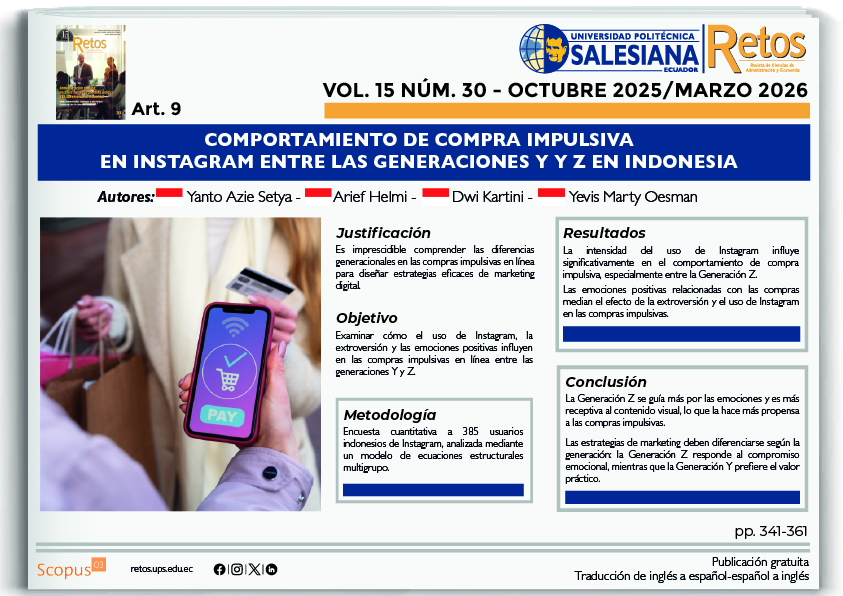
Instagram has become a major platform for online shopping, especially among the younger generation. Understanding the factors that
influence impulsive buying on social media has become increasingly relevant for marketers. This study examines the influence of Instagram usage
intensity, extroversion, and positive shopping emotions on impulsive buying behavior, with a particular focus on generational differences between
Generation Y and Generation Z. Data were collected from 442 respondents through a structured questionnaire and analyzed using SmartPLS 3.3.2
to test six hypotheses. Validity and reliability were assessed using Cronbach’s alpha, composite reliability, and average variance extraction (AVE).
Findings reveal that for Generation Z, frequent Instagram use and positive emotions significantly drive impulsive purchases. In contrast, for
Generation Y, extroverted personality traits have a stronger influence on buying decisions. These results highlight distinct psychological patterns
across generations in online shopping behavior. The study provides practical insights for marketers seeking to tailor their strategies to meet generational
preferences. By identifying different behavioral drivers, it contributes to the growing literature on digital consumer behavior and guides
brands operating in social media environments.
Article Details

This work is licensed under a Creative Commons Attribution-NonCommercial-ShareAlike 4.0 International License.
Authorship: The list of authors signing must include only those people who have contributed intellectually to the development of the work. Collaboration in the collection of data is not, by itself, a sufficient criterion of authorship. "Retos" declines any responsibility for possible conflicts arising from the authorship of the works that are published.
Copyright: The Salesian Polytechnic University preserves the copyrights of the published articles, and favors and allows their reuse under the Creative Commons Attribution-NonCommercial-ShareAlike 3.0 Ecuador license. They may be copied, used, disseminated, transmitted and publicly displayed, provided that: i) the authorship and the original source of their publication (journal, editorial and work URL) are cited; (Ii) are not used for commercial purposes; Iii) mention the existence and specifications of this license.
References
Alves, P., Martins, H., Saraiva, P., Carneiro, J., Novais, P., & Marreiros, G. (2023). Group recommender systems for tourism: how does personality predict preferences for attractions, travel motivations, preferences and concerns? User Modeling and User-Adapted Interaction, 33(5), 1141–1210. https://doi.org/10.1007/s11257-023-09361-2
Amiri, F., Jasour, J., Shirpour, M., & Alizadeh, T. (2012). Evaluation of effective fashionism involvement factors effects on impulse buying of customers and condition of interrelation between these factors. Journal of Basic and Applied Scientific Research, 2(9), 9413–9419.
Appel, G., Grewal, L., Hadi, R., & Stephen, A. T. (2020). The future of social media in marketing. Journal of the Academy of Marketing Science, 48(1), 79–95. https://doi.org/10.1007/s11747-019-00695-1
Bijari, B., Javadinia, S. A., Erfanian, M., Abedini, M., & Abassi, A. (2013). The impact of virtual social networks on students’ academic achievement in Birjand University of Medical Sciences in East Iran. Procedia-Social and Behavioral Sciences, 83, 103–106.
Bosnjak, M., Galesic, M., & Tuten, T. (2007). Personality determinants of online shopping: Explaining online purchase intentions using a hierarchical approach. Journal of Business Research, 60(6), 597–605.
Brand, B. M., Rausch, T. M., & Brandel, J. (2022). The importance of sustainability aspects when purchasing online: comparing generation X and generation Z. Sustainability, 14(9), 5689.
Bratko, D., Butkovic, A., & Bosnjak, M. (2013). Twin study of impulsive buying and its overlap with personality. Journal of Individual Differences.
Chan, T. K. H., Cheung, C. M. K., & Lee, Z. W. Y. (2017). The state of online impulse-buying research: A literature analysis. Information & Management, 54(2), 204–217.
Djafarova, E., & Rushworth, C. (2017). Exploring the credibility of online celebrities’ Instagram profiles in influencing the purchase decisions of young female users. Computers in Human Behavior, 68, 1–7.
Dobre, C., Milovan, A. M., Duțu, C., Preda, G., & Agapie, A. (2021). The common values of social media marketing and luxury brands. The millennials and generation z perspective. Journal of Theoretical and Applied Electronic Commerce Research, 16(7), 2532–2553. https://doi.org/10.3390/jtaer16070139
Dwivedi, Y. K., Ismagilova, E., Hughes, D. L., Carlson, J., Filieri, R., Jacobson, J., Jain, V., Karjaluoto, H., Kefi, H., Krishen, A. S., Kumar, V., Rahman, M. M., Raman, R., Rauschnabel, P. A., Rowley, J., Salo, J., Tran, G. A., & Wang, Y. (2021). Setting the future of digital and social media marketing research: Perspectives and research propositions. International Journal of Information Management, 59(July 2020), 102168. https://doi.org/10.1016/j.ijinfomgt.2020.102168
Gonzalez, E., Leidner, D., Riemenschneider, C., & Koch, H. (2013). The impact of internal social media usage on organizational socialization and commitment.
Gupta, S., Kushwaha, P. S., Badhera, U., Chatterjee, P., & Gonzalez, E. D. R. S. (2023). Identification of benefits, challenges, and pathways in E-commerce industries: An integrated two-phase decision-making model. Sustainable Operations and Computers, 4, 200–218.
Helmi, A., Oesman, Y. M., Kaltum, U., & Faisal, Y. A. (2023). The influence of hedonic values and extraversion on online impulse buying: Empirical evidence from Indonesia. Innovative Marketing, 19(1), 48.
Hendrawan, D., & Nugroho, D. A. (2018). Influence of personality on impulsive buying behaviour among Indonesian young consumers. International Journal of Trade and Global Markets, 11(1–2), 31–39.
Hoang, D., Kousi, S., & Martinez, L. F. (2023). Online customer engagement in the post-pandemic scenario: a hybrid thematic analysis of the luxury fashion industry. Electronic Commerce Research, 23(3), 1401–1428.
Huang, J.-H., & Yang, Y.-C. (2010). The relationship between personality traits and online shopping motivations. Social Behavior and Personality: An International Journal, 38(5), 673–679.
Huang, L.-T. (2016). Flow and social capital theory in online impulse buying. Journal of Business Research, 69(6), 2277–2283.
Hurdawaty, R., Wibowo, F. X. S., & Sulistiyowaty, R. (2023). Studying the Consumption Behaviour of Generations Y and Z towards Ready-To-Drink Coffee. International Journal of Travel, Hospitality and Events, 2(1), 10–26.
Isen, A. M. (1984). The Influence of Positive Affect on Decision Making and Cognitive Organization. Advances in Consumer Research, 11(1).
Iyer, E. S. (1989). Unplanned Purchasing: Knowledge of shopping environment and. Journal of Retailing, 65(1), 40.
Jin, S.-A. A., & Phua, J. (2014). Following celebrities’ tweets about brands: The impact of twitter-based electronic word-of-mouth on consumers’ source credibility perception, buying intention, and social identification with celebrities. Journal of Advertising, 43(2), 181–195.
Joo Park, E., Young Kim, E., & Cardona Forney, J. (2006). A structural model of fashion‐oriented impulse buying behavior. Journal of Fashion Marketing and Management: An International Journal, 10(4), 433–446.
Khan, N., Hui, L. H., Chen, T. B., & Hoe, H. Y. (2016). Impulse buying behaviour of generation Y in fashion retail. International Journal of Business and Management, 11(1), 144.
Kirschner, P. A., & Karpinski, A. C. (2010). Facebook® and academic performance. Computers in Human Behavior, 26(6), 1237–1245.
Koski, N., & Mesiranta, N. (2005). Impulse buying on the internet: encouraging and discouraging factors. In Frontiers of e-Business Research (FeBR) 2004 (pp. 23–35). Tampere University of Technology and University of Tampere.
Krbová, P. K. (2016). Shopping behaviour of generation Y: A comparison of Czech Republic and Slovakia. Acta Universitatis Agriculturae et Silviculturae Mendelianae Brunensis, 64(2), 617–626.
Kristi, G. O., & Aruan, D. T. H. (2023). Factors Affecting Online Impulse Buying Behavior of Fashion Products on Live: Instagram Vs Tiktok. Indonesian Interdisciplinary Journal of Sharia Economics, 6(3), 2163–2185.
Lajnef, K. (2023). The effect of social media influencers’ on teenagers behavior: An empirical study using cognitive map technique. Current Psychology, 42(22), 19364–19377.
Lee, C.-H., & Wu, J. J. (2017). Consumer online flow experience: The relationship between utilitarian and hedonic value, satisfaction and unplanned purchase. Industrial Management & Data Systems, 117(10), 2452–2467.
Nahai, N. (2017). Webs of Influence: The Psychology Of Online Persuasion. Pearson Business
Priporas, C.-V., Stylos, N., & Fotiadis, A. K. (2017). Generation Z consumers’ expectations of interactions in smart retailing: A future agenda. Computers in Human Behavior, 77, 374–381.
Rezaei, S., Ali, F., Amin, M., & Jayashree, S. (2016). Online impulse buying of tourism products: The role of web site personality, utilitarian and hedonic web browsing. Journal of Hospitality and Tourism Technology, 7(1), 60–83.
Robert, D., & John, R. (1982). Store atmosphere: an environmental psychology approach. Journal of Retailing, 58(1), 34–57.
Rook, D. W., & Gardner, M. P. (1993). In the mood: Impulse buying’s affective antecedents. Research in Consumer Behavior, 6(7), 1–28.
Rowley, J. (2002). Using case studies in research. Management Research News, 25(1), 16–27.
Stern, H. (1962). The significance of impulse buying today. Journal of Marketing, 26(2), 59–62.
Sudirjo, F., Lotte, L. N. A., Sutaguna, I. N. T., Risdwiyanto, A., & Yusuf, M. (2023). The Influence of Generation Z Consumer Behavior on Purchase Motivation in E-Commerce Shoppe. Profit: Jurnal Manajemen, Bisnis Dan Akuntansi, 2(2), 110–126.
Thomas, M. R., & Monica, M. (2018). Online website cues influencing the purchase intention of generation z mediated by trust. Indian Journal of Commerce and Management Studies, 9(1), 13–23.
Thompson, E. R., & Prendergast, G. P. (2015). The influence of trait affect and the five-factor personality model on impulse buying. Personality and Individual Differences, 76, 216–221.
Turkyilmaz, C. A., Erdem, S., & Uslu, A. (2015). The effects of personality traits and website quality on online impulse buying. Procedia-Social and Behavioral Sciences, 175, 98–105.
Verhagen, T., & Van Dolen, W. (2011). The influence of online store beliefs on consumer online impulse buying: A model and empirical application. Information & Management, 48(8), 320–327.
Weinberg, P., & Gottwald, W. (1982). Impulsive consumer buying as a result of emotions. Journal of Business Research, 10(1), 43–57.
Wilcox, K., & Stephen, A. T. (2013). Are close friends the enemy? Online social networks, self-esteem, and self-control. Journal of Consumer Research, 40(1), 90–103.
Zhang, K. Z. K., Xu, H., Zhao, S., & Yu, Y. (2018). Online reviews and impulse buying behavior: the role of browsing and impulsiveness. Internet Research, 28(3), 522–543.
Zhao, Y., Li, Y., Wang, N., Zhou, R., & Luo, X. (2022). A meta-analysis of online impulsive buying and the moderating effect of economic development level. Information Systems Frontiers, 24(5), 1667–1688.